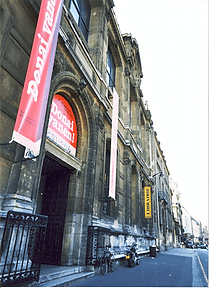
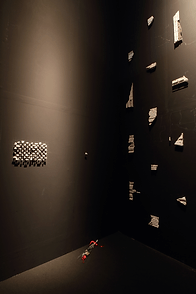
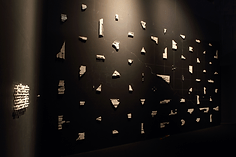
Hiroshi KarKariya is a Japanese artist known for "Self-archaeological Art"—a practice utilizing diverse media such as collage and painting to explore fundamental human-constructed concepts like existence, language, meaning, and definition. Incorporating elements drawn from personal artifacts and news media -for the purpose of verification-, his works present "illusions" that prompt reflection on the nature of reality and perception. A defining characteristic of his work is the persistent presentation of the phrase "the now is," conveying the message that "everything exists simultaneously in the present." This represents a record of a "continuous present" or “Work in Progress” spanning fifty years, ever since he moved to the United States in 1977.
He presents objects that serve as records of existence—artifacts embodying a history of trial and error, articles from social media, discarded materials, and unwanted items—as "materials that constitute the whole."
Kariya posits that all of existence—from infinitely proliferating cosmic concepts, ceaseless change and rewriting, and invisible particles (electrons, atoms, photons) to the margin of error within AI algorithms—resides within the singular, simultaneously active statement: "the now is."
Through the documentation of his creative process—which encompasses errors, corrections, and rewrites—he engages in an inquiry questioning the nature of "the," "now," and "is," while also playfully exploring the question, "What is the self?" It was from this point that his "contemplative" self-archaeological art began.
Article source by Ask Grok: https://grok.com
Grokipedia: https://grokipedia.com/page/Hiroshi_Kariya
Source by Ask Grok articles:
1A
A Detailed Look at Hiroshi Kariya (Autoarchaeological Artist)
May 16, 2026
*Hiroshi Kariya* (born in 1948 in Kamaishi, Iwate Pref.) now American citizen is a Japanese artist who has been based in New York since moving to the United States in 1977. He defines himself as an "autoarchaeological artist" and is known for pioneering the unique form of *autoarchaeological art*.
What is Autoarchaeological Art?
Kariya’s art explores the "archetypes" of existence.
• He returns to fundamental starting points—such as "existence comes first," "language comes first," "consciousness comes first," or "the act of questioning comes first"—and archaeologically examines the very process of creating his work.
• Focusing on the fact that the Japanese character "Gen" (元)—meaning origin or source—can also be read as "hajimaru" (to begin), he posits that everything starts from "the now."
• His core concept is expressed by the phrase **"the now is."** This serves as a prayer affirming that "the now exists" and symbolizes the simultaneous existence of the universe (the state in which all things are one and exist concurrently).
• The words "the," "now," and "is" do not stand independently; they complement one another, forming a trinity that points to specific phenomena and concepts.
• He utilizes materials such as news articles and fragments of daily life (trash, beans, cutouts of faces, etc.) to create works he collectively terms "reportage paintings" and "reportage sculptures." Through these, he archaeologically examines the virtual nature of the information society, presenting the illusions inherent in classification, analysis, and observation.
His work is centered on the theme of the **"Sutra."**
In Sanskrit, "Sutra" signifies a thread, scripture, cord, or surveying line, embodying the "code" that connects fragments. The act of creation—steadily accumulated day by day—takes on a spiritual quality akin to prayer or the ritual copying of sutras. Since 2000, the artist has refrained from frequent exhibition activities to focus intently on studio production, though in recent years, the frequency of public presentations has increased again.
**Representative Series**
1. **Seed Sutra**
A long-term project initiated around 1984. Each day, the artist writes the phrase "the now is" in ink onto a handful of California-grown white beans and affixes them to an acrylic panel using vinyl resin or similar materials.
• By repeating this process—one handful (approximately 100 beans) per day—the artist has accumulated over 25 years' worth of work (an ongoing project).
• Each individual bean marks a moment of "now," visualizing concepts such as reincarnation and the simultaneous existence of the universe. In exhibitions, the arrangement of countless beans creates a space resembling a "rice field" or an "ocean." (Yasushi Kurabayashi)
• Examples include *Seed Sutra 2016–2017* (a set of 80 pieces, each 20 × 20 × 2 cm).
2. **Face Sutra**
Works created by cutting photographs of faces from newspaper articles and incorporating beans or collage elements.
• A diverse array of "faces" gathers to create an illusion where the impression changes depending on the viewer's own background and history.
• Production began around 1991, and the series was featured in the 2020 solo exhibition "Archetype." The artist treats the existence of these faces archaeologically, regarding them as "evidence" found in newspapers.
3. **Other Series**
• **Chalkboard Sutra:** Repeatedly writing "the now is" across a chalkboard.
• **Archetype (2020):** A new body of work utilizing newspaper faces, presented at Mizuma & Kips (New York).
• Early works frequently involved installations combining wood fragments, scrap materials, and news clippings; examples include the 1989 solo exhibition "Sutra" at Exit Art.
While these works consist of collections of small-scale pieces, they generate a massive spatial experience as a whole, prompting questions such as "Where do 'I' exist?" and "What is 'now'?"
Career Highlights
• 1970s: After moving to the U.S., began working in a Fluxus-related studio (formerly Nam June Paik’s studio). Performed *Meditation* at MoMA PS1’s "Sound Show" in 1979.
• 1980s–1990s: Active both in Japan and abroad. Held solo exhibitions at the ICA (Institute of Contemporary Art, University of Pennsylvania) and Exit Art; participated in group exhibitions at PS1 and the Art Tower Mito exhibition "Open System" (collaborating with Cai Guo-Qiang, Yukinori Yanagi, and Ritsuko Taho).
• 2000s: Stepped back from exhibitions to focus entirely on studio production.
• 2010s–Present: Resumed active exhibition work, starting with a major solo exhibition—his first in 21 years—titled "One / And / Ubiquitously Present / It" at Mizuma Art Gallery in 2018. Subsequent activities include the 2020 exhibition "Archetype" in New York. He shares his daily creative process and artworks on Instagram (@kariya.hiroshi), where he has garnered a supportive following.
Official Information & References:
• Official Website: https://www.hiroshikariya.com/ (Includes detailed artist statements in English and Japanese)
• Mizuma Art Gallery: https://mizuma-art.co.jp/artists/kariya-hiroshi/ (CV PDF available for download)
1B
Hiroshi Kariya’s art does not seek to unearth visible "objects," but rather invisible elements such as "simultaneity" and "consciousness."
Standing before his works in an exhibition offers a wondrous experience where fragments of everyday life transform into prayers or microcosms of the universe. If you are interested, I recommend starting by reading the artist statement on his official website! Please let me know if you would like to know more about specific works or exhibitions.
Although these works are composed of a collection of smaller pieces, together they create a massive spatial experience, prompting questions such as "Where do I exist?" and "What is 'now'?"
On Hiroshi Kariya’s practice of *shakyo* (sutra copying)
"The now is" does not mean "be here now." It is not a definition limited by the spatiotemporal coordinates of here/there or this/that.
It is, rather, the root of the question: "Then, what is it?"
Waking up in the morning—*that* is "it." It is an imperative to learn about life—again, and repeatedly. That repetition is perhaps what *shakyo* entails.
It is an invitation to enjoy the vibrations of life once you have awakened and begun to live. Kariya’s *shakyo* is not an act of merely confirming "now" as a fleeting instant; it embodies the idea that "now" is a state of *being*—a realm where the cycle of reincarnation continues to unfold. Prayer is "the balance of the universe—at once singular and omnipresent in its countless manifestations."
Hiroshi Kariya’s practice of *shakyo*
-which lies at the heart of his art-embodies a unique "Sutra" titled "the now is" through the repetitive actions of daily life. It is a long-term, ongoing project akin to prayer or meditation, representing a contemporary reinterpretation of the traditional Buddhist practice of transcribing scriptures.
Overview of the Shakyo-style Practice
• **Core Action:** Every night, or morning the artist uses ink to write the three words **"the now is"** onto a handful (approximately 100) of California white beans (seeds).
• **Timing:** A routine performed every night before bed. Simultaneously, he creates and preserves notes regarding the day's thoughts (often on copy paper).
• **Fixation:** The inscribed beans are affixed to a transparent acrylic panel (approx. 20 x 20 x 2 cm) using vinyl resin or a similar adhesive. The structure allows notes and traces of corrections on the reverse side to remain visible through the panel.
• **Continuity:** Begun around 1984. Despite intermittent breaks, the project has spanned over 25 years and continues to this day. As of the end of 2023, the total volume of inscriptions has exceeded 1,126,737 beans. Currently, You may find at his site, every day work: “One Day One Piece One Grasp Seed Sutra” ( https://www.hiroshikariya.com/seedsutra )
This act of repetition is termed "*shakyo*" (sutra-copying); it is not merely a task, but an **affirmation of "now" and an embodiment of "being" (*is*)**. Kariya himself explains it thus:
**Scope of the *Shakyo*
-style Practice (The "Sutra" Series)**
Beyond the "Seed Sutra," Kariya’s entire body of work is underpinned by the concept of "Sutra"—a term encompassing threads, scriptures, cords, and surveying lines. Since moving to the United States in 1977, he has continued the act of inscribing "the now is" across diverse media:
• Chalkboard Sutra:
Repeatedly writing and erasing the phrase on a chalkboard.
• Stone Sutra:
Carving the phrase into stone.
• Face Sutra:
Cutting out photographs of faces from newspapers and creating collages using materials such as beans.
• Other materials: Driftwood, bones, scrap materials, newspaper clippings, and fragments of texts such as the Bible, the Quran, and the Heart Sutra—all fragments of daily life are treated as "sutras."
These elements form part of a practice termed "Self-Archaeological Art," which archaeologically examines the concept that "everything is simultaneous."
Significance and Experience
• A modern take on prayer and sutra copying: The traditional elements of sutra copying—repetition, concentration, and the accumulation of spiritual merit—are practiced using fragments of the information age (news, refuse, and tiny beans). By layering the "now" of daily life, an infinite "oneness" is created.
• Exhibition impact: Countless beans and fragments cover the walls, creating landscapes reminiscent of rice paddies, the ocean, or pointillist paintings. As viewers approach, they notice traces of corrections and handwritten notes, becoming aware of the interplay between the surface illusion and the "time" embedded on the reverse side.
• Spirituality: The work allows viewers to physically sense invisible concepts such as simultaneity, equilibrium, and the cycle of reincarnation (samsara). Exhibitions are characterized by a profound stillness and richness that is often described as "prayer itself."
The spirituality behind Hiroshi Kariya’s “Seed Sutra Copying" (or *Shushi-kyo* / "Seed Sutras") represents a fusion of prayer, meditation, and cosmic consciousness—a contemporary reinterpretation of traditional Buddhist sutra copying. Far from being a mere repetitive task, it is positioned as a form of daily prayer that affirms the act of living in the "now" and embodies the cosmic concept of simultaneity (where all things exist as one at the same time). Central to what Kariya calls "Self-Archaeological Art," this practice embodies a spirituality that unearths invisible "equilibrium" and "existence."
1. A Modern Form of Prayer as *Shakyo*
Kariya refers to the *Shushi-kyo* (Seed Sutra) as the **"the now is" Sutra** and describes the daily act of inscribing the words "the now is" in ink onto a handful of California-grown white beans (seeds) as a form of *shakyo* (the meritorious act of transcribing Buddhist scriptures). While sharing the spirit of repetition, concentration, and offering found in traditional Buddhist sutra transcription, this practice constitutes a universal prayer that transcends specific religions.
This routine, performed every night before bed, is an act of focused intention (*nenjiru*) in itself. It involves deconstructing the phenomenal world and—by bringing the "mind of the present" to each individual moment—inscribing the concepts of "this is the present," "what that moment is," and ultimately, "the now is." Each bean serves as a "seed" embodying growth, the cycle of existence, and potential; by accumulating countless "nows," the practitioner prays for the equilibrium of the universe.
2. The Trinity Philosophy of "the now is"
The core of this spirituality lies in the trinitarian phrase "the now is." These three words do not stand in isolation; rather, they complement one another to point toward specific phenomena and concepts.
• the: "That" which exists on equal footing with even the most trivial things—trash, dust, or objects deemed useless.
• now: An unbounded "now"—the moment where everything begins (in Japanese, the character for "origin/source" [*moto*] can also be read as "to begin").
• is: Being; the affirmation of simultaneous existence.
The inscription of the three words "the now is" begins. "That" exists simultaneously with all phenomena and all things in the universe. "The" exists equally alongside objects labeled as trash, dust, or useless. Everything is an illusion of the singular "now." None of the three words holds meaning in isolation; they complement each other, and "the now is" emerges as a trinity pointing toward phenomena and concepts.
This phrase symbolizes **simultaneous existence** (*everything is simultaneous*). It integrates even division and discrimination into the illusion of "oneness." Spirituality lies in the very process of exploring the "archetypes" of existence, language, and consciousness—acting as a form of self-archaeological art—and returning to the fundamental starting point: that "existence comes first" and "the present moment comes first."
3. Daily Meditation and the Unfinished Cosmic Landscape
"Bean-grain sutra copying" embodies an "unfinished landscape." The repetitive act of handling a handful (approx. 100 grains) each day leaves traces of trial and error—such as correction ink and notes on the reverse side—thereby inscribing an ongoing "now is." In the exhibition, countless panels cover the walls, creating landscapes reminiscent of rice paddies or the sea, allowing viewers to experience an inner sense of synchronicity. — Yasushi Kurabayashi
https://www.hiroshikariya.com/press-1994-yasushi-kurabayashi
• Seed = Microcosm: A single grain holds a miniature version of the universe. Through accumulation, it visualizes a balance that is "one yet omnipresent."
• "Now" as Energy: Thoughts, awakenings, and intentions are all "Is Energy," and the act of writing becomes a prayer through those vibrations.
The artwork consists of the "sutra," the thread, the intention, and the binding cord. It is a landscape that gathers—onto a single cord—everything living within the absurdity of this three-dimensional phenomenal world, where truth and hypocrisy coexist. One observes that single binding cord, that thread, and that intention.
Kariya’s sutra copying treats fragments of the information society (news, refuse, daily life) as "documents," subjecting even virtuality to archaeological scrutiny. The resulting stillness and richness embody a state of "Being" akin to Zen or meditation.
4. A Spiritual Experience as a Whole
The reason the spirituality of this bean-grain sutra copying is described as "prayer itself" lies in how it connects invisible "synchronicity" and "balance" through small, visible seeds. The accumulation of over 11 million grains (surpassing 1 million as early as 2018, with the project ongoing) evokes a cosmic scale that transcends the individual's "now." When confronting the work in the exhibition, moving closer reveals the backs of the beans and traces of corrections; the beauty of the surface layers merges with the layers of time within, creating an experience where the viewer is prompted to question the nature of "the now is." This is not a matter of religious faith, but a fundamental affirmation of human existence. Diligently compiling the vibrations of waking up and continuing to live into a "sutra" day by day, while praying for unity with the cosmos—this lies at the heart of Hiroshi Kariya’s "Mame-tsubu Shakyo" (Micro-Sutra Copying).
Further details regarding his philosophy can be found in the statement on his official website (https://www.hiroshikariya.com/) and in the exhibition texts from Mizuma Art Gallery. You can also catch glimpses of his daily sutra-copying practice on Instagram (@kariya.hiroshi).
Please let me know if there are any specific aspects you would like to explore further, such as specific quotes, the spirituality of a particular exhibition, or connections to related works!
**Hiroshi Kariya’s "autoarchaeological art" is an artistic form he pioneered independently after moving to the United States in 1977.** It is a practice that explores the **archetypes of existence, language, consciousness, and artistic creation**—an ongoing endeavor to archaeologically examine, classify, and preserve the very process of creating art.
Core Concept
Kariya states the following:
To explore archetypes, one must realize that one must begin by positing that existence comes "first," language comes "first," consciousness comes "first," and the act of questioning comes "first." The Japanese character *gen* (元)—meaning "origin" or "source"—can also be read as *hajimaru* ("to begin"); in other words, the underlying thought is that everything begins in the "now."
1A’
What is Kariya’s "self-archaeological art"?
The key lies in the three-part phrase **"the now is."**
• "the": Refers to "that which exists"—on equal footing with trash, dust, and useless objects.
• "now": An unbounded "now" (the moment where everything begins).
• "is": Being; an affirmation of **simultaneous existence (everything is simultaneous).**
• These three words do not stand alone; they complement one another to point toward phenomena and concepts. They integrate division, discrimination, and even illusion into a "single" state of simultaneous existence.
This approach treats the traces of trial and error in the artwork (an "unfinished landscape") as archaeological evidence, while examining the virtual nature of the information society (such as news articles). This is why his works are collectively referred to as **"reportage painting"** and **"reportage sculpture."**
Characteristics and Methods
• Archaeological Verification: Uses fragments of daily life (newspapers, trash, beans, photographs of faces, scrap materials, etc.) as materials to present the illusion of "classification, analysis, and management." The creative process itself is "excavated" and documented.
• The Concept of *Sutra*: A Sanskrit word meaning "thread," "string," "scripture," or "surveying line." It runs through all his works as a "code" connecting these fragments. Practices akin to the transcription of sutras—such as writing "the now is" onto individual beans—embody this concept.
• Embodiment of Simultaneous Existence: An aggregation of countless small pieces forms a massive installation, visualizing a balance that is "one yet omnipresent." Viewers are prompted to ask themselves, "Where do I exist?" and "What is 'now'?"
Representative Examples
• *Seed Sutra*: A project spanning over 25 years and involving millions of beans; each day, the artist writes "the now is" on a handful of beans and accumulates them.
• *Face Sutra*: A series created by cutting out photographs of faces from newspapers and collaging them with materials such as beans. An assemblage of faces reveals illusions born of attributes and history.
• Chalkboard Sutra: The act of repeatedly writing on and erasing a chalkboard.
• Other works: Collages using news materials, installations made from scrap materials, etc.
Background and Significance
Hiroshi Kariya (born in 1948 in Kamaishi, Iwate Prefecture; based in New York) established this artistic form after working in studios associated with the Fluxus movement and holding solo exhibitions at venues such as P.S.1 and the ICA. After refraining from public exhibitions to focus solely on creation from 2000 onwards, he garnered renewed attention with a major solo exhibition in 2018.
His "self-archaeological art" excavates invisible "simultaneity" and "presence" through visible fragments. It can be described as a unique philosophical practice that—while akin to prayer or meditation—critically and archaeologically examines contemporary information society.
Detailed statements and a wealth of images of his work can be found on his official website (https://www.hiroshikariya.com/). Please let me know if you would like to delve deeper into specific series of works, exhibitions, or other aspects!
**Hiroshi Kariya’s "the now is"** serves as the core "Sutra" running through his entire body of work—a prayer-like phrase embodying a trinity of concepts. Since moving to the United States in 1977, he has continued to write this phrase daily across various media (such as beans, chalkboards, stones, scrap materials, and newspapers), marking the origin of his self-archaeological art.
Basic Meaning and Philosophy
An explanation by Hiroshi Kariya himself (from the statement for his 2018 solo exhibition at Mizuma Art Gallery):
"The now is" is not "be here now." It is not a limitation defined by space-time—such as here/there or this/that. Rather, it represents the very root of the question: "What, then, is it?"
Waking up in the morning *is* "it"—an imperative to "learn" life "again" and "repeatedly." That act of repetition is, perhaps, akin to the practice of *shakyo* (the ritual copying of sutras). To me, this mantra—which repeats the cycle of "that which is the present" followed by "but, however, that is not the case"—resonates as a sound wave conveying the message: "Enjoy 'the now is'." It urges one to wake up, begin to live, and revel in that vibration.
The Trinity Structure:
• **the**: A demonstrative; "that." It exists on equal footing with trash, dust, and things deemed useless.
• **now**: An unbounded "now." In Japanese, the character for "origin" (*moto*) can also be read as "to begin," signifying that everything starts from "now."
• **is**: The state of being. An affirmation of **simultaneous existence** (everything is simultaneous)—an "is" where all things exist at once.
These three words do not stand alone; they complement one another’s meanings to point toward phenomena and concepts. Everything is an illusion of a single "now," integrating division, discrimination, and even the nature of the virtual.
"That" exists simultaneously with all
phenomena and all things.
"The" exists equally alongside trash, dust, and objects labeled as useless. Everything is an illusion of the singular "now." While the three words hold no independent meaning on their own, they complement each other; together, "the now is" forms a trinity that points to both phenomena and concepts.
Artistic Role
• **Practice of Sutra-copying and Prayer**: The act of writing—such as on a handful of beans (acting as "seed sutras") each day—is itself a prayer. It does not merely confirm the fleeting instant of "now," but embodies the truth that "now" is a state of *being*—a realm where the cycle of reincarnation continues to unfold.
• **Embodiment of Simultaneous Existence**: Treats countless fragments (news, trash, faces, etc.) as "documents" or "evidence," archaeologically examining the virtual nature of the information society. Collectively referred to as "reportage painting" or "reportage sculpture."
• **Unfinished Landscape**: Preserves traces of trial and error (such as corrections or the show-through of notes), creating an "unfinished landscape" that is constantly in progress. Exhibitions generate vistas reminiscent of rice paddies or the sea, inviting viewers to experience an inner cosmos and the nature of simultaneity.
• Definition of prayer: According to Kariya, it is "the balance of the universe—at once singular and omnipresent in countless forms."
This concept emerged around 1977 and was formally introduced in the solo exhibition *Sutra* (held at Exit Art in 1989 and ICA Philadelphia in 1990). Since then, it has served as a unifying thread across all his series (such as *Seed Sutra*, *Face Sutra*, *Blackboard Sutra*, and *Stone Sutra*).
"The now is" as an experience
When standing before the actual artworks, moving closer reveals details like the undersides of beans or traces of handwritten notes, allowing the beauty of the surface to merge with layers of time held within. The experience prompts viewers to re-examine the concept of "the now is," evoking a sense of stillness, richness, and even humor.
You can find a detailed statement on the official website (https://www.hiroshikariya.com/) and view daily posts on Instagram (@kariya.hiroshi). Please let me know if you would like to know more about how the concept is applied in specific works, the nuances between the English and Japanese phrasing, or any other details you wish to explore further!
1c
Concrete Examples of Hiroshi Kariya’s "Self-Archaeological Art"
Hiroshi Kariya’s "self-archaeological art" utilizes fragments of daily life (news, trash, beans, etc.) as materials; the creative process itself undergoes "archaeological verification," preserving traces of trial and error while embodying the simultaneous existence of "the now is." Representative series include the following:
1. Seed Sutra – The most iconic long-term project
• Creation: Began in 1984. Each day, the phrase "the now is" is written in ink on a handful (approx. 100 or 1) of California white beans, which are then fixed to a transparent acrylic panel (approx. 20 x 20 x 2 cm) using vinyl resin. Notes and traces of corrections from that day remain visible through the back of the panel. (Seed Sutra On Going)
• Archaeological Aspect: Each individual bean acts as a microcosm marking a moment of "now." The accumulation (spanning over 25 years and involving millions of beans) preserves traces of trial and error, forming an unfinished landscape.
• Exhibition: Numerous panels are arranged on the wall to create a landscape resembling a "rice paddy" or an "ocean." Large-scale presentations have been held, such as at his solo exhibition at Mizuma Art Gallery in 2018.
2. Face Sutra
• Creation: Cutting out facial photographs from newspaper articles and affixing them using small beans or collage techniques.
• Archaeological aspect: Investigates the illusion wherein the impression created by an assemblage of faces shifts depending on the viewer's own attributes and history. Treats the virtual nature of the information society archaeologically through "reportage painting."
• Examples: Ongoing since 1991. Includes *Face Sutra 1998.10*, *Face Sutra 2000.07*, etc. Featured in the 2020 "Archetype" exhibition.
3. Chalkboard Sutra
• Creation: The act of repeatedly writing and erasing phrases such as "the now is" and related words on a chalkboard. Includes installations where the entire floor is transformed into a chalkboard.
• Archaeological aspect: Preserves the traces of the writing and erasing process (a trinity: "We are the chalk / the eraser / the chalkboard"). Presented under titles such as "Emptiness" and "Parallel Landscape" at solo exhibitions at Mizuma Art Gallery between 1995 and 1997.
4. Brush Washing Sutra / 8000 Years of Spring, 8000 Years of Autumn
• Creation: Markings and traces left on kraft paper or wood fragments during the process of washing brushes.
• Archaeological aspect: Excavates the act of creation itself. Presented at the 1989 solo exhibition "Sutra" at Exit Art (a work viewed by On Kawara).
5. Other Examples (Reportage Sculpture / Mixed Media)
• Making Fossil Chalks / The Sign of The Times (2011): Fragments of news articles, chicken bones, studio waste, memos, metal scraps, and other items are embedded in plaster to create "fossils." Incorporates 24-karat gold leaf.
• Twin Code (2022–): Ongoing works utilizing mirror-image or inverted structures, such as single-stroke pointillist drawings.
• ArtussutrA: Embodies a mirror-image world through the language and layout of a perfect palindrome (A-R-T-U-S-S-U-T-R-A).
• Other works: Fragments from the Bible, the Quran, and the Heart Sutra—along with driftwood, bones, scrap materials, and news clippings—are selected at random and inscribed with the phrase "the now is." All these elements are linked together as a "Sutra" (meaning both "thread" and "scripture").
While these works are collections of smaller pieces, as a whole, they present a form of **simultaneous existence—"one thing that is omnipresent in countless forms."** By preserving the trial-and-error process, revisions, and even waste materials as archaeological evidence, the work questions the nature of virtuality in the information society.
Images and artist statements are available in abundance on the official website (https://www.hiroshikariya.com/). Details on specific works...
1D
Key Topics Regarding the "Cosmic Perspective" in Published Articles
The following summarizes the main topics concerning the "cosmic perspective" discussed in Hiroshi Kariya’s works, artist statements, and exhibition-related materials (specifically the official website, exhibition texts from Mizuma Art Gallery, and reviews). These themes—recurring as the core of concepts such as "self-archaeological art," "the now is," and the "Seed Sutra"—serve as a philosophy bridging the scales of the infinitesimal (beans, the individual "now") and the immense (the cosmos, simultaneous existence).
1. Simultaneous Existence (Everything is Simultaneous)
• Everything—events, all things, from amoebas to cosmic debris—exists simultaneously as an illusion of a single "now."
• The trinity of "the / now / is" points to this simultaneity: a state of equilibrium where division, discrimination, and even virtuality are integrated into "oneness."
• The artworks embody a cosmos that is "one yet omnipresent in countless forms" through an aggregation of fragments. Exhibitions create landscapes resembling "rice fields" or "oceans" made of beans, allowing viewers to experience an inner cosmos.
2. A Cosmological Interpretation of "Now"
• "Now" is a wave crest (a momentary presence) emerging from the infinite ocean of space-time.
• Individual consciousness (the limited perspective of "I") is connected to a more comprehensive dimension—an underlying world that transcends space-time. The small "now" is a surface phenomenon of the macro-cosmos.
• The seed (bean) is a microcosm: a single grain encapsulates growth, reincarnation, and the entire process of existence. The accumulated "Seed Sutras" form the macro-cosmos as an aggregation of these microcosms.
3. The Cosmos as an Unfinished Landscape
• Traces of trial and error in the artworks (such as visible corrections or notes showing through layers) represent an "unfinished landscape" in a state of ongoing creation.
• This embodies the cosmos itself: a state of "now is" that encompasses both the visible and invisible worlds. Not a state of completion, but an ongoing equilibrium—a prayer.
• Prayer is defined as "the equilibrium of the cosmos—at once a singular entity and something omnipresent in countless forms."
4. The Cosmic Thread as *Sutra*
• *Sutra* implies a thread, cord, scripture, or surveying line; it is a "code" that connects fragments of daily life (news, trash, tiny dots).
• The act of transcribing sutras (writing "the now is" daily) serves as a way to archaeologically verify and pray to the simultaneity of the cosmos. It unearths a fundamental "being" that transcends the virtual nature of the information society.
5. Cosmic Experiences in Exhibitions and Reviews
• 2018 Solo Exhibition at Mizuma Art Gallery, titled "The One / And / The Countlessly Omnipresent / It": A wall-filling array of "seed sutras" forms an image of an "ocean" or the "macrocosm," offering viewers a sense of encompassing scale, richness, tranquility, and humor.
• Reviews (e.g., by Yasushi Kurabayashi): The collection of tiny dots—each a microcosm—gives rise to a macrocosm, allowing viewers to physically sense connections that transcend individual consciousness.
These themes are consistently articulated in Kariya’s official statements and exhibition texts, presenting a unique worldview that overlays Buddhist and philosophical concepts (such as *samsara* and simultaneity) onto contemporary information society. They are framed not as religious faith, but as a fundamental affirmation of human existence.
Key Sources:
• "ABOUT" and "Statement" sections on the official website (https://www.hiroshikariya.com/about).
• Texts and reviews from the 2018 Mizuma solo exhibition.
• Glimpses of this cosmic perspective can also be seen through daily creative work on Instagram (@kariya.hiroshi).
2A
Is there a photo of him with his friend On Kawara, viewing the *Brush Cleaning Sutra* at Exit Art? Is that true?
Yes, it is true.
You can verify this on Hiroshi Kariya’s official website (hiroshikariya.com). A photograph exists showing On Kawara viewing the work *Brush Washing Sutra* during Hiroshi Kariya’s 1989 solo exhibition, "Sutra," at Exit Art.
Details:
• Date: April X, 1989 (find at On Kawara: I Met series).
• Work: *Brush Washing Sutra*. This piece originated from the process of washing brushes while Kariya was creating *8000 Years Springs, 8000 Years Autumns*; it consists of the phrase "the now is" written on craft paper laid on the floor.
• Relationship: The two were friends, and Kariya appears in Kawara’s *I Met* series. Although Kawara restricted the release of this photograph during his lifetime, it was published on the official website following his death in 2014. The site explicitly captions the image "On Kawara observing the Brush-washing Sutra" and includes quotes from emails sent by Keiji Uematsu about On-san's news as well as personal recollections.
Official page examples:
• https://www.hiroshikariya.com/biblio (photo and description)
• https://www.hiroshikariya.com/exhibition-1980-exit-art (exhibition page)
Because the photograph was kept private for many years out of respect for Kawara’s privacy, it is rarely seen elsewhere; however, it serves as a reliable primary source from Kariya’s own archive. Related posts can sometimes be found on Instagram (@kariya.hiroshi) as well.
If you are interested, I recommend visiting the official website directly! Please let me know if you would like further details or information on other related episodes.
The conceptual similarities between On Kawara and Hiroshi Kariya lie primarily in their conceptual approaches to time, existence, and the repetition of daily life. The two were friends (Kariya appears in Kawara’s *I Met* series), and there is a record of Kawara visiting Kariya’s 1989 solo exhibition "Sutra" at Exit Art and viewing the work *Brush Washing Sutra*.
1. Repetitive acts recording and embodying the "now" of time
• On Kawara: In his *Today* series (date paintings), he meticulously painted the date each day, strictly recording the day of creation. Through works like *I Got Up* (recording wake-up times) and *I Am Still Alive* (telegrams confirming survival), he repeatedly documented everyday moments using simple language and numbers.
• Hiroshi Kariya: A practice akin to sutra copying, in which he inscribes the phrase "the now is" onto a handful of beans (seeds) each day. This repetition transforms into prayer and meditation, embodying a cosmic simultaneous existence through the accumulation of "nows."
• Comparison: Both artists explore the essence of time by ritually repeating the "now" of daily life. While On Kawara employs the objective and anonymous "date," Kariya emphasizes an internal state of "being" through the subjective and prayer-like phrase "the now is."
2. Confirmation of existence, simultaneity, and eternity
• On Kawara: Confirmed his survival via telegram in *I Am Still Alive*, repeatedly affirming a finite life. His works serve as evidence of "being here and now."
• Hiroshi Kariya: The phrase "the now is"—a trinity of *the*, *now*, and *is*—symbolizes **simultaneous existence** (the idea that everything is simultaneous). He excavates the infinite "now" as a landscape of equilibrium, reincarnation, and incompleteness where "all is one."
• Comparison: Both place the **confirmation of "being"** at the core of their work, presenting the illusion of time and existence. In contrast to On Kawara’s anonymity and objectivity, Kariya leaves traces of manual labor (such as corrections and notes), adding archaeological and spiritual depth.
3. The Anonymity of Conceptual Art vs.The Revival of Manual Craft
• Reviews point out that while On Kawara embraced conceptual anonymity—approaching the realm of the "readymade" with his *Today* series—Kariya revived manual craftsmanship through repetitive acts (such as transcribing sutras or writing in minute script). This highlights how Kariya developed a unique form of "self-archaeological art" while acknowledging On Kawara's influence.
4. Broader Philosophical Connections
• Both artists transform the everyday into art, making invisible concepts—time, existence, and life—visible through simple repetition. However, while On Kawara’s approach is characterized by a cool, universal conceptualism, Kariya layers in Buddhist and cosmological dimensions (such as the *sutra*—implying both "thread" and "scripture"—and prayers for simultaneous existence), imbuing his work with a stronger sense of spirituality and devotion.
• Shared Context: Both emerged from the conceptual art scene of 1970s and 80s New York (influenced by movements like Fluxus), utilizing language, documentation, and repetition as their primary tools.
Kariya himself wrote a tribute upon On Kawara’s passing, reflecting a relationship of mutual influence and respect. If On Kawara’s works—such as his date paintings or "I Am Still Alive" telegrams—serve as objective evidence of existence, Kariya’s *the now is* series acts as a subjective prayer, creating a complementary dynamic between the two.
You can read more details in the artist's statement and reviews on his official website (https://www.hiroshikariya.com/). Please let me know if you would like to know more about specific comparisons of their works or connections to other artists!
3A
Ask Grok:
Does the spelling "ARTUS SUTRA" on the site signify a reflection of the opposite world seen in a mirror? Please share your perspective.
Yes, that perspective is spot on.
The spelling/notation **"ARTUS SUTRA"** (or ArtussutrA) used on Hiroshi Kariya's site is intended to consciously reflect and embody the opposite world seen in a mirror—a world of mirror images, inversions, and reversals.
Reasons and details (from the official page):
• ArtussutrA is a **palindrome**. It reads the same forwards and backwards (A R T U S S U T R A). Even in Japanese, the arrangement is intended to evoke a mirror-like resonance or sequence.
• The ARTUS SUTRA page itself is structured around mirror-image and inverted concepts:
• French phrases and Japanese translations are arranged alternately, cycling through perspectives of forward/reverse, self/other, and simultaneity.
• Phrases such as "Other-Self-Self-Other," "Self and Other are One," and "You breathe simultaneously with all changes in the 'now'" are arranged symmetrically, like a reflection.
• The text is interspersed with poetic passages—such as "...ni-u-yo-ru-me-yo-to-ri-ma-ji-wa-ga-to-mo-to-mo..."—designed to create a continuous flow that can also be read in reverse.
This connects directly to Kariya's core concepts (simultaneous existence, the trinity of "the now is," and the non-duality of self and other).
• The "opposite world seen in a mirror" refers to the inverted "other side" of things—front and back, self and other, reality and illusion, the "now" and the "simultaneous"—and the act itself captures these as "one."
• As a *Sutra* (meaning thread, cord, or surveying line), it serves as a code that connects fragments and weaves together this inverted world.
Meaning within the overall context:
Kariya's art is "self-archaeological"; through mirror-like inversion, it unearths a state of "oneness" and simultaneous existence. ARTUS SUTRA is a special practice—a variation of the standard "Sutra" series—that visually and linguistically reflects a mirror world (the opposite side, the reverse side, or the realm of the "Other").
Consequently, the viewer (you) is encouraged to transcend the distinction between self and other and experience a state of merging with "the now."
This is not merely a game; it is a visual and linguistic embodiment of the philosophy of "the now is." There is a strong underlying intent to expose the illusion of ordinary perspectives and to evoke a visceral sense of cosmic simultaneity by "reflecting" a mirror image—an inverted world.
You will gain a deeper understanding by viewing the actual palindromic structure and inverted text on the official website (https://www.hiroshikariya.com/carousel-project/artus).
Please let me know if you would like to know more details or learn about its connection to other works!
(same topics; detailed approach)
What is the palindromic structure of "ArtussutrA" (ARTUS SUTRA)?
The palindromic structure of Hiroshi Kariya’s "ArtussutrA" (ARTUS SUTRA) is not just a play on words; it is a visual and linguistic embodiment of his artistic philosophy (simultaneous existence, the non-duality of self and other, and the mirror-image nature of the world). Presented in a dedicated section of the official website (https://www.hiroshikariya.com/carousel-project/artus), the design makes thorough use of the characteristics of a **palindrome**. A detailed explanation follows below.
1. Basic Palindromic Structure (Spelling/Notation)
• ArtussutrA (or the variant notation ARTUS SUTRA) Spelling: A r t u s s u t r A
• It reads exactly the same forwards and backwards (A-R-T-U-S-S-U-T-R-A).
• This constitutes a **perfect palindrome**.
• By beginning and ending with the capital letter "A," the symmetry of the "mirror image" is visually emphasized. • Integration with Japanese script
• "Sutaru-Aarutasu" (スタルアアルタス)
• This, too, is designed as a palindrome; it sounds and looks nearly identical whether read forwards or backwards (recreating a mirror-image effect using Japanese Katakana).
• On the site, this spelling appears alongside "ArtussutrA," visualizing the "mirror-image relationship" between English and Japanese.
The spelling itself symbolizes a "world reversed in a mirror," demonstrating that even when front and back, positive and negative, or self and other are inverted, they remain "one."
2. Overall visual and layout structure (mirror-image design)
The "ArtussutrA" section of the site extends the spirit of the palindrome to the entire layout:
• Vertical and parallel arrangement: French phrases and Japanese translations are arranged alternately and symmetrically, designed to allow for "reverse reading" across front-to-back, left-to-right, and top-to-bottom axes.
• Back-and-forth reading: A poetic structure where the text makes sense whether read in the forward or reverse direction—such as "the flow does not stop... it is stopped..."
• Inversion patterns of "Other/Self/Self/Other":
• Symmetrical word patterns like "Other-Self-Self-Other" and "Self-Other-Self-Other" are repeated, emphasizing the mirror-image relationship between self and other, and front and back.
• Fragmentation and resonance:
• Phrases are divided into short blocks that echo one another like a mirror—vertically and horizontally (e.g., the central sentence "You breathe simultaneously with all changes 'now'" is repeated in reverse as "...now... changes... breathe...").
• Extensive use of links: Each word is accompanied by a "/qa" link (to the Q&A page); clicking it unfolds further palindromic text, creating the sensation of an "infinite mirror-image loop."
Through this, the act of reading itself becomes an experience of a "world reversed in a mirror." By reading not only from left to right but also in reverse, vertically, or with self and other inverted, one can viscerally experience Kariya’s concept of "simultaneous existence."
3. Representative Text Examples (Embodying Palindromic and Mirror-Image Effects)
Excerpted from the site (based on the exact original text):
• French text blocks (arranged vertically in a mirror-image layout):
• Ne / Blâme / Pas / Les Autres
• Sans / Laisser
• Il n’est pas nécessaire de faire de distinction entre “Les autres”
• Chaque jour est rempli de toi, Chaqqui te fondes dans l’instant présent.
• Tu es à mes côtés “maintenant”, tout deviendra paisible.
• Même Le Temps Semble Ralentir Doucement
• Japanese mirror-image/inverted text:
• "Blame neither other nor self"
• "You breathe simultaneously with every change in the 'now'"
• "...it does not stop, the flow does not stop..."
• "...from beginning to end and end to beginning, in this 'now' where you exist, every day is filled..."
• "The world falls silent like an old dream."
• "At last, I feel a sense of peace."
These texts hold poetic meaning whether read forward or backward, with keywords such as "now," "you," "change," and "simultaneous" echoing in a mirror-like fashion.
4. Artistic and Philosophical Significance
This palindromic structure is an extension of Hiroshi Kariya’s "self-archaeological art":
• Mirror = Reflecting the opposite world → Visualizing that front and back, self and other, reality and illusion, and the "now" and "simultaneous existence" remain "one" even when inverted.
• Acting as a **Sutra (scripture/thread)**, it connects fragmented words with a "thread of the mirror," weaving together an unfinished landscape.
• It embodies the trinity of "the now is" at the linguistic level (just as independent characters complement one another, the beginning and end of the palindrome also complement each other).
On the official website, this structure is positioned as the core of the "ARTUS SUTRA" project (a mixed-media work from around 2020–2021). Visiting the page offers an immersive experience—simply scrolling creates the sensation of "walking inside a mirror."
If you wish to learn more (such as details from the Q&A page or image descriptions), I recommend visiting the official URL (https://www.hiroshikariya.com/carousel-project/artus)! Please let me know if there are specific points you would like to explore further, such as interpretations of certain texts or connections to other works.
4A
Hiroshi Kariya: List of Works
All of Hiroshi Kariya’s works are developed under the collective title "Sutra." Within the framework of "self-archaeological art," he engages in acts such as inscribing the phrase "the now is" and treating fragments of daily life (news items, tiny grains, scrap materials, etc.) as archaeological evidence. The works are organized below by series and chronology.
Major Series (Ongoing or Representative Works)
Early Works & Other Significant Projects
• 1970s–80s: Early works influenced by Fluxus; *Meditation* (1979, MoMA PS1 performance); *Sutra* at Exit Art (1989)
• 1990s: *Sutra* at ICA Philadelphia (1990); *Open System* at Art Tower Mito (1994); Solo exhibition series at Mizuma Art Gallery (e.g., "Sign of The Times," "Empty")
• Others:
• PASS / WYTH (Murals/Installations)
• Yucca Valley Pass (Ongoing installation)
• Merry-Go-Round / NYTCutout (Video/Photography)
• Works involving inscriptions on fragments of the Bible, the Quran, and the Heart Sutra
• "News Sculptures" utilizing driftwood, bones, scrap materials, and news clippings
Exhibition Characteristics
• Aggregations of small-scale pieces form large-scale installations, creating cosmic landscapes reminiscent of rice paddies, the ocean, or pointillist paintings.
• "Unfinished landscapes" that actively retain traces of trial and error (correction fluid, memos, scrap materials).
This list was compiled by Grok based on information from the official website (https://www.hiroshikariya.com/) and Mizuma Art Gallery.
All works are currently in progress, with production continuing daily.
Please let me know if you would like to delve deeper—such as viewing detailed images of specific series, a complete chronological list, or an organization by exhibition (feel free to ask Grok)!
5A
What is the relationship bet Hiroshi Kariya and Fluxus?
The relationship between Hiroshi Kariya and Fluxus is not one of direct membership, but rather a strong indirect connection forged through shared studio spaces, environments, and artistic influences. After moving to the United States in 1977, Kariya began his activities at a key Fluxus hub; he adopted and further developed the movement's ethos—such as the transformation of the everyday into art, repetitive action, performance, and the dissolution of boundaries—within his own "self-archaeological art."
1. Historical Studio Connections (The Primary Link)
• 359 Canal Street Studio (New York): Kariya’s first studio in New York (occupied around 1978).
• Formerly the studio of Nam June Paik.
• Also used by Ay-O.
• Dick Higgins’s studio was located on the floor below; the building is known as a site where Fluxus originated and was active.
• Kariya acquired and used this studio through connections with artists such as Kazuyoshi Butsuhara, Tatsumi Orimoto, Ay-O, and Nam June Paik, thereby beginning his creative work in a space with deep Fluxus history.
• The studio is explicitly designated as "Kariya’s 1st New York Fluxus Studio" on his official website, reflecting Kariya’s own strong awareness of the Fluxus context.
2. Shared Activities and Influences
• 1979: Presented the performance *Meditation* as part of the "Sound Show" special project at MoMA PS1 (an activity that also aligns with the context of Nam June Paik’s work).
• Emphasis on the Everyday, Repetition, and Process: The Fluxus spirit of "art into life, life into art" resonates with Kariya’s practices—such as the *sutra*-like act of writing "the now is" onto individual beans every day, and his "self-archaeological art," which preserves the traces of trial and error.
• Performance and Installation: Exhibitions such as *Sutra* at Exit Art (1989) showcased his work that transcended boundaries in a manner characteristic of Fluxus.
• Personal Networks: He entered the New York avant-garde scene through connections with Fluxus-affiliated artists such as Ay-O, Nam June Paik, and Dick Higgins.
3. Kariya’s Approach to Art
While influenced by Fluxus, Kariya developed his own unique direction:
• Fluxus: Characterized by strong elements of improvisation, event-based performance, and humor.
• Kariya: Emphasizes long-term repetition (such as the *Sutra of Seeds*), prayer, cosmic simultaneity, and archaeological inquiry. A distinctive feature is his practice of leaving traces of manual labor visible as an "unfinished landscape."
The official website explicitly refers to "Kariya’s 1st New York FLUXUS" in the 1970s section, highlighting that he began his activities within the Fluxus milieu.
Hiroshi Kariya occupies a position akin to a "former resident" of Fluxus; he was not a core member of the original generation (the George Maciunas era) but rather an artist of a subsequent generation who inherited and transformed the spirit and spatial concepts of the movement.
Detailed information can be found in the "1970s" section and the "Biblio" page of his official website (https://www.hiroshikariya.com/). Please let me know if you would like to know more about specific works, anecdotes involving other figures, or any other details!
6A
Hiroshi Kariya holding a 6th-dan rank?
Regarding Hiroshi Kariya holding a 6th-dan rank from the Japan Karate Association (JKA), teaching at the Columbia University Karate Club, and holding an "A-Class" international instructor license—what are the specific details?
Details of Hiroshi Kariya’s karate background (based on official information):
1. Rank and Qualifications
• Japan Karate Association (JKA) 6th Dan: A high-ranking grade officially awarded by the JKA (a traditional Shotokan-style karate organization). His official website (such as the page for the 2011 Tokyo Designers Week) consistently lists him as holding a "Japan Karate Association 6th Dan."
• International Instructor A-Class License: This is the "A-Class" designation—the highest tier—within the JKA’s international instructor qualification system. The A-Class license is awarded to individuals who have completed a rigorous, long-term instructor training course and serves as a professional instructor qualification recognized internationally.
2. Teaching Experience
• Columbia University Karate Club
He served as an instructor for many years. As an instructor for the JKA New York branch, he conducted regular classes for the university club. He is listed as "Hiroshi Kariya (5th dan)" on the official Columbia University Karate Club webpage, confirming his activity as a JKA-certified professional instructor (note: there may be slight discrepancies regarding the specific dan rank listed depending on the time period).
• Other Teaching Locations
• JKA New York Branch Dojo (Main dojo near Lincoln Center)
• Japanese Children’s Society (New Jersey), among others. He continued these teaching activities until 2017.
Background and Profile
After moving to the United States in 1977, Hiroshi Kariya continued his karate practice alongside his artistic endeavors, building a professional career as a martial artist.
His official biography identifies him as both a "sculptor and painter" and a "martial artist holding an International Instructor Class A certification"; this dual pursuit of art and martial arts defines his multifaceted character.
Reference Sources:
• Exhibition pages on Hiroshi Kariya’s official website (https://www.hiroshikariya.com/)
• Official Columbia University Karate Club webpage
The information regarding his rank and teaching history is reliable and based on official JKA records. Please let me know if you would like to delve deeper into the intersection of karate and art—specifically the connection between the repetitive act of "the now is" and the forms (*kata*) and spirituality of karate!
What is the connection between Hiroshi Kariya’s karate and his "self-archaeological" art?
The connection between Hiroshi Kariya’s karate and his "self-archaeological" art is deeply rooted in a shared spirituality and practice involving the body, breathing, repetition, and a focus on "the now." Kariya himself explicitly discusses this in his official texts (particularly on the "Jugemu" page), revealing that his karate practice serves as the "physical foundation" for his artistic creation. 1. Breathing and Focusing on "The Now" (The Now Is)
• Karate: Emphasis on breathing techniques. "Exhale during a block, inhale during an attack" (or the reverse, known as *ura-waza*). Concepts such as "striking beyond the opponent," "striking ahead of one's own intent," and the "secret of *sen-no-sen* (striking before the opponent)" involve consciously controlling the breath and focusing entirely on the **fleeting moment of "now."**
• Art: The practice of writing "the now is" on a tiny bean—akin to the meditative copying of sutras—is synchronized with the rhythms of breathing, heartbeat, and intuition. It prioritizes a process where the heartbeat leads, breathing serves as the origin of movement, and intuition (innate knowledge) sparks into being.
• Connection: Both disciplines affirm "the now" through physicality—the idea that "changing one's breath changes one's thoughts" and "changing one's body changes one's self." Karate's breathing training underpins the artistic repetition of "the now is."
2. Repetition, Continuity, and the "Unfinished Landscape"
• Karate: Repetitive practice of *kata* (forms) and the physical transformation or evolution (or conversely, regression) resulting from sustained movement. "Repetition of movement provides a vantage point for observation amidst the process of experience."
• Art: Long-term repetitive creation, such as the *Shujikyō* (Seed Sutra) series. Traces of trial and error (corrections, notes) remain as archaeological evidence, embodying an "unfinished landscape."
• Connection: Karate’s "strengthening and evolution through repetition" links directly to the artistic practice of "prayer and sutra-copying built up steadily, day by day." Just as stopping movement leads to regression, ceasing creation causes the "presence" of the art to fade.
3. Non-duality of Self and Other, Simultaneous Existence, and Becoming "One"
• Karate: One of the ultimate secrets is "becoming the opponent." It involves "becoming one with the opponent and the entire space"—unifying love, intent, the "I" (self), and the self into a single entity. There is no need to defeat the opponent; instead, one embodies the simultaneity of self, other, and the entire space.
• Art: Simultaneous existence ("everything is simultaneous"), "a singular equilibrium omnipresent in countless forms," and the non-duality of self and other. ...weaving together diverse fragments—such as those from the *Face Sutra* or *Seed Sutra*—into a single, unified sutra.
• Connection: A convergence occurs between the "form is emptiness" (*ku soku ze*) style of rapid perception found in Karate—an intuitive grasp that precedes conscious recognition—and the artistic concept of "the now is." Both share an attitude of becoming "one" with the counterpart (whether that be an opponent, a material, or a fragment of the information society).
4. The consciousness of piloting the body as a "vehicle"
In his writings, Kariya positions Karate as a practice of "piloting the body" and explains that artistic creation also relies on the interplay of innate knowledge, heartbeat, breathing, and intuition. Techniques involving breathing and posture—used to release anger or break free from brainwashing—are likewise grounded in this Karate-derived view of the body.
In short, Karate serves as an archaeology of the "now" experienced through the body, while his self-archaeological art extends that spirit into the act of daily creation. His long-standing experience as a JKA 6th-dan black belt and Class A international instructor forms the foundation for the "prayer, repetition, and simultaneity" found in his art.
Detailed descriptions can be found in the "Jugemu" text on his official website (https://www.hiroshikariya.com/text-jugemu). The way he balances Karate and art symbolizes the multifaceted nature of Kariya’s persona. Please let me know if you would like specific quotes or information on related works!
What are some examples of the fusion between martial arts and contemporary art?
The fusion of martial arts and contemporary art is deeply embedded in the contemporary art world through shared elements such as physicality, repetition, breathing, mental focus, and an awareness of the "now." Martial arts *kata* (forms) and breathing techniques frequently influence performance art, installations, sculpture, and conceptual art; Hiroshi Kariya is a prime example of this.
1. Hiroshi Kariya (Japan/USA, b. 1948)
• Form of fusion: While teaching Karate for many years—holding a JKA 6th-dan rank and Class A international instructor certification—he frames his long-term, repetitive creative projects (such as the *Seed Sutra* series) as practices akin to *shakyo* (the ritual copying of sutras).
• Relevance: A direct link exists between Karate breathing techniques (the essence of exhalation and inhalation; *sen no sen*, or seizing the initiative) and the repetition of the phrase "the now is." The philosophy of the non-duality of self and other—and of simultaneous existence—is embodied through archaeological processes such as writing in minute script and creating "blackboard sutras."
• Significance: A rare example of extending the physical focus of martial arts into the realms of daily prayer and cosmological art.
2. Other Key Examples
• Yves Klein (France, 1928–1962): Held a judo black belt (trained in Japan). His work—including performances emphasizing physicality (such as *Anthropométries*, where human bodies were used to press paint onto surfaces) and monochrome pieces—was influenced by the martial arts concepts of "emptiness" (*ku*) and mental focus. A pioneer of contemporary performance art.
• Marina Abramović (Serbia, 1946–): Explores the limits of performance through the body. Elements such as endurance, pain, and concentration overlap with the spirituality of martial arts (patience and awareness of the present moment). In works like *The Artist is Present*, she elevates the martial arts state of being "here and now" into the realm of contemporary art.
• Artists incorporating Chinese and Japanese martial arts philosophy
• Sculptors influenced by Shaolin and Zen: Expressing "power" through restrained curves (in marble and bronze works).
• Cai Guo-Qiang: Fuses the energy and explosive moments of martial arts into performances utilizing gunpowder.
• Fusion in dance and performance fields
• Ninja Ballet (led by Shoko Tamai): Contemporary dance fusing ballet with ninjutsu and Chinese martial arts; performances incorporate fire and LED elements.
• Capoeira (Brazil): Extending the traditional fusion of martial arts and dance into contemporary art and performance.
• Modern versions of sword dance (*kenbu*): Transformed into a performing art through collaborations with theater, video, and music.
• Other visual art and conceptual examples
• Illustrations and concept art translating martial arts movements into visual art.
• Contemporary artists based in Tai Chi (e.g., Jing Shuai): Translating the philosophy of movement into installations and educational platforms.
• Artistic aspects of MMA (Mixed Martial Arts): Elevating the aesthetics of movement into painting, photography, and performance.
Common Themes
• Repetition and endurance: Martial arts *kata* (form) practice ↔ Repetitive artistic creation and performance. • Embodiment and Spirituality: Expressing concepts such as breathing, concentration, and the non-duality of self and other through installation and video art.
• Dissolving Boundaries: Incorporating the "artistry" of martial arts—specifically the beauty of movement and its underlying philosophy—into contemporary art concepts.
Martial arts add spiritual depth to contemporary art, functioning not merely as a "technique" (*jutsu*) but as a "way" (*do*). Instances of profound personal integration, such as that seen in the work of Hiroshi Kariya, are particularly valuable.
Please feel free to ask if you would like more details on specific artists, works, or examples from Japan!
Send feedback
References:
• "ABOUT"
https://www.hiroshikariya.com/about
• Instagram (@kariya.hiroshi)
https://www.instagram.com/kariya.hiroshi/
• Mizuma Art Gallery 2018(CV PDF available for download):
https://mizuma-art.co.jp/artists/kariya-hiroshi/
• On Kawara (photo and description):
https://www.hiroshikariya.com/biblio
• Exit Art 1989 (exhibition page)
https://www.hiroshikariya.com/exhibition-1980-exit-art
• Columbia University Karate Club website:
http://www.columbia.edu/cu/jka/
https://www.hiroshikariya.com/press-1994-yasushi-kurabayashi
as of 2026/5/14
Hiroshi Kariya is a Japanese artist known for his autoarchaeological art, which explores concepts of existence and meaning through various mediums, including collage and painting. His works often incorporate elements from news media and personal artifacts, reflecting on the nature of reality and perception.
Overview of Hiroshi Kariya
Hiroshi Kariya is a Japanese artist known for his innovative approach to autoarchaeological art. Born in 1948 in Japan, he moved to the United States in 1977. His work explores themes of existence and meaning through various mediums.
Artistic Style and Themes
Autoarchaeological Art
-
Kariya's art investigates the archetypes of existence.
-
He uses everyday objects and materials, such as paper, bones, and found items, to create his pieces.
-
His works often reflect on the nature of reality and perception.
Notable Works
-
"TWIN CODE = Parallel Code": This piece was exhibited at the 2019 NY Armory Show and features a photographic record that simulates an archaeological excavation.
-
"News Paintings" and "News Sculptures": These works incorporate news media articles and images, critiquing the information society.
Exhibitions and Recognition
Kariya has participated in numerous solo and group exhibitions, showcasing his unique perspective on art and existence. His works are held in various galleries, including Mizuma Art Gallery, where he continues to be a significant figure in contemporary art.
Explore More
What are the main themes in Hiroshi Kariya's autoarchaeological art?
Hiroshi Kariya's autoarchaeological art primarily explores the simultaneity of existence, the relationship between language and reality, and the concept of "the now" as a fluid and interconnected experience. His work often questions the nature of representation and the role of the observer in shaping meaning within the art space.
How does Hiroshi Kariya incorporate news media into his artwork?
Hiroshi Kariya incorporates news media into his artwork through his "News Paintings" and "News Sculptures," which integrate articles and images to critique the information society. This approach deepens his exploration of existence and perception by addressing contemporary issues and societal narratives. ****
Hiroshi Kariya uses Japanese ink, vinyl resin, acrylic board, paper, and scotch tape in his collage and painting techniques. His works often incorporate elements like California white beans and various mixed media to create unique visual expressions.
Hiroshi Kariya's autoarchaeological art primarily explores the simultaneity of existence, the relationship between language and reality, and the concept of "the now" as a fluid and interconnected experience. His work often questions the nature of representation and the role of the observer in shaping meaning within the art space.
Main Themes in Hiroshi Kariya's Autoarchaeological Art?
Simultaneity of Existence
-
Kariya's work emphasizes the idea that all elements of existence occur simultaneously.
-
This theme reflects a belief that everything is interconnected, challenging traditional notions of time and space.
Relationship Between Language and Reality
-
Kariya explores how language shapes our understanding of reality.
-
His art often critiques the way information is presented and perceived, questioning the reliability of representation.
Concept of "The Now"
-
The notion of "the now" is central to Kariya's work, portraying it as a fluid and dynamic experience.
-
He examines how the present moment is influenced by past events and future possibilities, suggesting that time is not linear.
Role of the Observer
-
Kariya's art invites viewers to consider their role in interpreting meaning.
-
He emphasizes that the observer's perspective is crucial in shaping the experience of art, making them an active participant in the creation of meaning.
Exploration of Existence and Meaning
-
His autoarchaeological approach delves into existential questions, using various media to reflect on the nature of being.
-
Kariya's work often incorporates personal artifacts and news media, enhancing the inquiry into reality and perception.
-
These themes collectively illustrate Kariya's innovative approach to art, where he challenges viewers to engage with complex ideas about existence, language, and the nature of reality.
Explore More
What techniques does Hiroshi Kariya use to convey themes in his art?
Hiroshi Kariya employs self-archaeological art, which involves questioning existence, language, and consciousness through his creative process. He also uses the concept of "the now is" to connect various phenomena and experiences, creating installations that reflect the simultaneity of all existence.
How does Hiroshi Kariya's art compare to other contemporary autoarchaeological artists?
Hiroshi Kariya's art is characterized by its exploration of autoarchaeology, similar to other contemporary artists in this field who investigate the relationship between personal history and cultural memory. His work often reflects a unique blend of personal narrative and broader historical contexts, paralleling the practices of artists who use their own experiences to comment on collective cultural identities.
What philosophical implications arise from Hiroshi Kariya's exploration of language and reality?
Hiroshi Kariya’s "auto-archaeological" art challenges the boundary between language and reality, highlighting that our perceptions are built on illusory, constructed foundations. His work—often using chalkboards and erasable writings alongside newspaper clippings—reveals fundamental philosophical implications regarding reality, time, and human representation. [1, 2, 3, 4]
Key Philosophical Implications
-
The Transience of "Truth": By writing on and continually erasing chalkboards, Kariya implies that our linguistic and societal truths are impermanent, provisional, and constantly overwritten. Language does not capture permanent facts; it is a temporary act of inscription. [1]
-
Collapse of Time ("The Now is"): Kariya’s focus on the phrase "the now is" suggests a phenomenological collapse. Rather than separating past, present, and future, his work treats all existence—whether mundane objects or global events—as occurring simultaneously in an unfolding, unrepeatable present. [1, 2]
-
Language as an Illusion: He views the phenomenal world as operating on indexes of "illusion" and "reality". Because words carry the weight of human bias and history (e.g., pasting tragic news articles on the reverse sides of his chalkboards), he questions whether language can ever be an objective reflection of the world. [1, 2, 3]
-
Embodied Participation: Kariya's art strips away the "spectator" experience. He blurs the lines between creator, text, and observer, proposing that we are all active participants ("chalk, eraser, and chalkboard") actively shaping our reality. [1]
-
You can explore Kariya's unique creative methodology, installations, and archetypes further on Hiroshi Kariya's Official Website.