HIROSHI KARIYA


"I think, therefore I am"
Cultural Tutor
"I think, therefore I am."
Rene Descartes, who came up with this idea in the 1630s,
never actually said it.
Rene Descartes (1596-1650), French philosopher.
Descartes wrote in French and Latin.
In 1637, he wrote: je pense, donc je suis.
In 1647, he wrote: cogito, ergo sum.
Abbreviation
Considerations:
1. All flowers have petals.
2. A rose is a flower.
3. Therefore, a rose has petals.
This is a syllogism.
Descartes's idea:
1. Only that which exists can think.
2. I think.
3. Therefore, I exist.
In 1765, philosopher Antoine Thomas
I doubt, therefore I think.
I think, therefore I exist.
Søren Kierkegaard pointed out that the "I" I think about presupposes existence, making it a tautology and eliminating the need to say "I exist."
Nietzsche believed that Descartes's doubt was incomplete because he did not even doubt that I or my thoughts might exist.
Sealed20Chalk211201Writing
You2021exist2021120101how20211201002know20211201003
with no20211201004experiencing20211201005it20211201005y
ourself20211201006said?"
said20211201007。Gaston
de「Journey to the 4th Dimension」20211201008Pavlovsky.
I remain20211201009silent and my own actions20211201010never cease.
「Three explanations0120of200existence」20211201011have been given.
「Convert explanations into20211201012phenomena」
Bringing「phenomena」into202112010013existence20211201
①These are transformed014renamed015exchanged016reduced017and018continued.
②They are not019limited020therefore021undefined022
③023They are024virtually025realized201026by201027intension.
①They28are artificial2021and2030free from031space-time032and033density
②201034They035are virtual036real201037experiences.
③20211201038They are039intensionally1040manifested1201041
①Definition of Definition ②Explanation043of explanation③Dogma045of Dogma

"Fossil Chalk" NY times article cutout, mixed with plaster, "the now is" inscription, 1997
Does A World Without Me Exist?
The concept of self and other things is an artificial doctrine, developed by someone. Doctrines contain questions such as: what teaches, what is taught, what, and for what purpose?
Doctrine, truth, propositionalization, dogma, etc. are artificial, theoretically induced languages. They are said to be man-made truths of the human world, guidelines for human life. Words are also things. Things are Kotodama. They are loudly declared sacred. Words are the combination of actual images, sounds, and meanings, and if believed, they transform into Kotodama. Things are objects, people, and MONO. MONO is a unit of oneness, a unit of Kotodama that contains everything. If existence is one = MONO, then everything can be understood. If all existence is one = MONO, then terms like division, discrimination, non-value, criticism, and judgment become unnecessary.
Observer → We, the self. We present what we see and what is seen. The observer arranges a grid, a hidden operation. Operations, roles, and purposes are hidden. Everything is simultaneous: the entire world is one; everything is one; everything is one and all; simultaneously realizing and changing. With change comes a subtle choice. Right or left? Heads or tails? Like flipping a coin. The observer is, of course, free. They are the actors, the confronters, the observers of events. The choice is arbitrary, whatever the choice, even if they change their mind. We are the masters of choice. That choice receives a posthumous name, a number on which paint drips. Records are preserved. Records are preserved as a single document of evidence, simultaneously with all events.
Records are "this, that, none of these, everything," a series of "but already not." They exist in arbitrary "temporary frames." They are temporary "*inflammances." Its nature is temporary, its essence is fleeting, "as it is." Learn and play while "continuing to record" the never-ending scenery.
*Inflammance: A conceptual term coined by Marcel Duchamp. It refers to a clear ambiguity, a thinness so extreme that even the perception of thinness is lost...
The artworks are traces of scratches, stains, and the continuation of time's symbols that "explain" "its" "existence." In the exhibition space, the spatial arrangement, related to the realm of time and space, and the integration of the viewer's different experiences, are reflected in the illusion.
The landscape is a continuous flow of "this, that, none of these, everything" and "already not that." These are the inflammances of temporal phrases. The landscape is a never-ending series of "record phrases," as if to say, "it is like that," an illusion that defies absolute perspective.
Description is a behind-the-scenes job that repeatedly changes along with the phenomena and objects. In the exhibition, the grid arrangement of time, space, and space is intentional, a landscape in which the "archetypes, relationships, explanations, and time" of linguistic information are artificially observed.
Alongside the three-character traces, there is also a "moment of time" that represents the virtual "present"; it serves as a guide to doubts and contradictions regarding the veracity of sociolinguistic information, which is an embodiment of fluidity and change, such as words, titles, objects, faces, symbols, signs, titles, and codes.

Acrylic and ink on seeds, collage of photographic article cutouts, 6x4 feet, 2018, Private collection
A double-sized "Mother," the prototype of this work, was exhibited at the front of the booth. The work is titled OSDLM2018 : "One Stroke Dotted Line Mizuma." The subtitle, "Twin Code," alludes to my own birth and creation as a twin. The opening day of the New York Armory Show, where the work was exhibited, coincidentally happened to be the anniversary of my mother's death. The subtitle of this work is also "Twin Code." The surface bears scratches, stains, and traces of successive time symbols that "explain" "its" "existence," and is part of the "Seed Sutra" and "Face Sutra" works that I have been working on since 1996.
varnanam parivartanaprakriyayam vartate, "etat, tat, na etesham dvayoh api" iti. "astitvasya sarvatrikayugpatpramanam" iti api drashtum shakyate . astitven sah yugpat, sarvavastunam udbhavah, vastu, varnanakriyayah yugpat vidyamanasya jivasya gatih. varnanam "astitvasya
記述は「これである、それである、それらいずれでもない」変化の途上。それは「存在普遍同時性の証」にも見える。それは存在、一切万物の生起と同時であり、ことであり、記述行為と同時に存在する生命体の動きである。記述は「存在普遍同時性の証」。それは一時的な「仮フレーム」に封じ込められた「フレーズ」の「しゅ」となるオブジェである。(上記はサンスクリットの音記述、意味はどうでも良い。音)

"One-stroke dotted line" Composition of the 4 works. 8"x8"=1 work. Mixed Media, 2017
2018 Dreams are Reality, Reality is Programmed Illusion
Olga Brakhmedi, Independent Curator / @artkukhnia
Hiroshi Kariya says that the code resides in "indexes that point to illusion and indexes that point to reality." The world distorts reality, and art seeks to restore awareness of the distinction between illusion and reality. The code is not outside, it is within you.
Olga Brakhmedi, "All About One Work and Countless Other Works," Mizuma Art Gallery, Tokyo, 2018

And You Are That Source
2018
"We all come from the same source, and we are that source."
His work, "The Now Is," is affixed to palm-sized clear acrylic panels each day, in quantities about the size of a handful of seeds. On any given day, "The Now Is" exists within itself, and at the same time, the countless acrylic panels seen in the gallery are a repetitive accumulation. The clusters of seeds, each painted with a different pattern on the acrylic panel, collectively form a massive movement of tiny particles.
Another part of this exhibition series, "Face Sutra," was also on display. Images of news articles of human faces were collaged onto the surface of each seed and affixed to the acrylic panel, with the "article name" or "work number" written on the other side.
Shinichi Takashige, BLOG: Real Tokyo Review, January 13, 2018
Memo For My Body
A Memo for the Body
The body contains the thoughts and habits of the mind, making it difficult to heal. If you believe that it would work. It's up to your subconsciousness.
Perception of existence = experiences, events, names, sensations, memories, and discrepancies with perception. Other than that, constructed combinatorial logic = virtuality, merely labeled rational, mathematical, and scientific. Experience is a characteristic of this third-density, material world, where hidden mechanisms create illusions using words, language, and pulses. Pulses create the illusion of holographic images. With awareness, you can choose with willpower.
You are the master. It's not "Believe, and you will experience," but "Act first, then believe." Creation begins, paradoxically. Imagination begins before action. It begins with organizing and cleaning your surroundings. The source of creation = action.
Karate instruction incorporates breathing techniques. When blocking, you exhale, and when attacking, you inhale. Some karate practitioners probably think it's the other way, but there's a hidden meaning. In the "sen-no-sen" technique, attacks are thrust with the secret of the pulling hand, and are lightning-fast. Thrusting the opponent before the breath. Thrusting before one's will. The exhale is anticipated. Act before one's consciousness within.
The logic behind creating art is acquired through innate knowledge. Allowing the body to automatically master it = utilizing it in the art of creation. The source of bodily movement begins with breathing. The heartbeat occurs first, and is the source of brain function. The heartbeat vibrations are innate knowledge. The living body comes first, not through mere learning. The heartbeat begins with the brain, and intuition arises. Heartbeat concentration begins simultaneously with breathing. Breathing is the source of movement and a direct experience of life. The rhythm of the heart and lungs gives rise to brain pulses = intuition. Be aware of the systemic waves flowing through the organs. Elementary particles become visible.
Breath distributes and reflects the state of each physical part, structuring it. Scientific reaction changes interact with the domain, form, and surrounding circumstances and conditions, distributing themselves in ever-changing ways.
One of the secrets of karate is to become one with your opponent. "Oneness" means becoming one with yourself, your opponent, and the whole. In other words, "love," "will," and "I"—becoming one with yourself, a state in which there is no need to defeat your opponent. That's why "submission" is called the secret.
In the case of humans, for example, it must start with the body. Your body changes according to the situation, changing accordingly. As your body moves, your shape changes. As your body changes, your breathing changes. As your breathing changes, your thoughts change. And as your thoughts change, you change. Even if the repetition is the same, it changes and evolves with application and experience. If you stop moving, the opposite happens. If you believe that you will degenerate depending on how you apply it, you will degenerate. Conversely, if you decide not to degenerate, you won't degenerate. It all depends on how you apply it.
Repetition of movement provides a vantage point from which to observe the process of experience. Concrete relationships within an organization, where many social strata are closely intertwined and interconnected, are sometimes reflected and influenced by the consciousness of the process.
When you run, your breathing changes because you need more oxygen than usual. Your breathing changes as you run, and as your breathing changes, your thoughts change to reflect the situation. The thoughts of a runner correspond to thoughts related to running.
Thoughts made during exercise are reflected in the consciousness of others. Unconscious vibrations are transmitted.

"About Burned" - Drawing of 12 hours of emotion after 8 hours photo shooting at PS1, sketch for canvas painting, 1979
Sen-no-Sen
In Tibet, they say that if you're angry, run a little. Run around your house two or three times, then come back and see where your anger has gone. When you run faster, your breathing changes. As your breathing changes, you sense the relationship between your body and your surroundings speeding up like a landscape. In other words, your environment changes, and the speed at which you experience time shifts. Even the movements and thoughts of ordinary people may seem slow. In the world of karate, speed lies in techniques that determine the outcome in an instant. In reality, it's a quick observation, where the opponent falls just before you can make the move. This is called intuition, and it occurs before recognition or perception. With repeated training, your opponent's ability is revealed in your ability to read their speed. By mastering the speed of their breathing techniques and matching their timing, you can strike at the very essence of emptiness—a technique known as the "precedence of the beyond"=Sen-No-Sen.
Existence is not limited to what can be seen. This is an example of experiencing the changes that occur when your body, existing among different beings in the invisible world, is exposed to these changes. Observe the invisible being, and align your thoughts with the image of bodies arranged in parallel, as if sitting in the sky. This is a way to visualize the imaginary drill in the present. Artists should be familiar with this. You can do it by closing your eyes. It's happening all the time, without you even realizing it. You can either let it go unconsciously, or you can ritualize your concentration and connect it to your innate abilities, or it can come true through experience. By deciding, you can "intentionally" concentrate, easily and meaninglessly, as if lightly throwing it away with your mind.
If you observe this principle, you may not need to run. Just take five or six deep breaths. Inhale, exhale, inhale, exhale. Then "intentionally" observe where the anger has run off to. Change the carelessness of your thoughts by using your body. Find the place where anger or fear has disappeared. Anger is, after all, a meaningless illusion. All you need to do is observe where the illusion comes from. Use the carelessness of human thought as a positive method of observation. If you can discover the great power of freedom in that carelessness, you will see a glimmer of light in the darkness of an enormous amount of possibility.
The strength of beliefs varies with age. The younger you are, the quicker you can train, but the older you are, the greater the strength of the imprinting. Whether or not you can break all brainwashing without relying on DNA reconnection depends on the methods, forms, and ritualistic self-imprinting training and practice. This is also one of the goals of learning. When you feel like you're almost there, you always feel like you're just one step away. If you can do it slowly and comfortably, repeat the self-suggestion, training, strengthening, and refinement as appropriate, but it's important to keep going.
It's generally true that thoughts and emotions are difficult to change instantly. So be optimistic and think that it's easy to change your body, then your breathing, and then just accept that anger doesn't exist. To quickly forget this simple principle is brainwashing. So write it down or forget it. It's okay if you can't do it right away. It's natural that your spirit will change again. You exist as "one" function. Simply feel that spirit at your leisure.
If you go to Jesus, Muhammad, or Buddha, they might tell you to "let go of your anger." If you feel angry, it's because you have breathing patterns that promote anger, a habit of taking words literally, a habit of receiving them directly, and a habit of not noticing the brainwashing pulse and reacting to brainwashed self-blame. This dark discipline invites anger. Observe your programmed self, hold your breath in the void in between, and act as long as you can for 10, 20, 30, 40, or 50 seconds. You'll learn the trick in an instant.
You are the master of freedom, and even if you struggle to let go of your anger, that's okay. Such a person must have been a very high-ranking being who chose the difficult experience necessary to learn it. Usually, the more angry you are, the more tired you become, and eventually, you'll put an end to this cycle. The reason I'm writing about breathing is because the more angry you are, the more distracted your breathing is, and the less oxygen you receive. It's good to develop the habit of breathing deeply and slowly. In times of crisis, I take three deep breaths. Once you can do this when it's not necessary, you're close to your goal. This will help you discern your breathing patterns and rhythms.
If you have a certain breathing rhythm, it's because of a certain posture. You'll begin to learn how to breathe with a straight back and proper posture. Anger is often caused by poor posture, not taking deep breaths, or physical discomfort. Next, you might be imitating someone else and watching too many abusive scenes on TV, or meditating between deep breaths. I recommend subconsciously surrendering to your inner self and practicing introspection between breaths.
The body is the grossest, and the mind the most subtle. Imaginations arise endlessly. If they don't arise, choose something in front of you by chance, or change your mind immediately. You are the master. If you get bored of it, just sleep, rest, or let it go.
One method is to start with your posture. We live our lives so absent-mindedly that we have never observed it, but when we have a certain mood in our minds, we always adopt a specific posture related to it. For example, can you stay relaxed when you're angry? That would be difficult. If you're angry, your posture will change. If you're sleepy, your posture will change.
So, you could intentionally try coming up with postures that are considered completely inappropriate. A posture that doesn't adhere to any concept for three minutes. A posture that changes every minute. A posture when you're happy. A posture of happiness. You could also try giving these postures words. Completely meaningless words. You could also imitate images that you find positive, images of animals or plants that don't fit any existing concepts. Even just a big image and that's all.
9/5/2014
Regarding Mr. Nakamori, he used to be a lawyer in New York and a collector. After 9/11, he went back to college and is now the curator of photography at the Houston Museum of Art.
Take care. K&N

I'm a paragraph. Click here to add your own text and edit me. It's easy.
359 Canal St, third floor, was Kariya Hiroshi's 1st studio, before he moved to Brooklyn. He purchased the studio through Kazuyoshi Butsuhara, Tatsumi Orimoto, Ay-O, and Nam June Paik. Trump Management was the renter. Plastics Store was on the first floor. Dick Higgins apparently lived on the second floor. Known only to those in the know, this is the birthplace of FLUXUS.
Peter Frank, Cyril Javachev (Christo's son), Yasunao Tone, Ulf Kahlen, Benni Efrat, Alex Katz, Yoyo Friedrich, Wolfgang Louis, Johannes Lenhardt, Hilmar Beuyel, Raimond Bamberg, Goethehaus, Barbara Wallace, Yoshishige Furukawa, Risaburo Kimura, Hiromitsu Morimoto, and Mimi Morimoto attended Plastics parties and so on.

On Kawara observing the Brush-washing Sutra. Exit Art, Kariya Hiroshi "Sutra" exhibition, 1989
On Kawara
8/3/2014
H, thanks for your email. I also found out about On-san's passing on July 11th from a friend's phone call in Dusseldorf. I had heard he was suffering from cancer when I visited New York in May. I also heard that his wife, H, was caring for him.
It feels like the end of an era. Yesterday, at the National Museum of Art, Osaka, I saw On-san's "I am still alive" telegrams. One of them was one I sent by following him to the postbox near my studio in Dusseldorf.
It was May 17, 1981.
Take care! I heard On's Twitter account is still up and running.
Keiji Uematsu
(02/08/14 0:46), hiroshi kariya wrote:
I found out about On-San's passing on July 10th while I was at a karate training camp. (with my respect, I call Mr. On Kawara, as On-san)
It's so early! ...81, or was I AM STILL ALIVE a work made for this day?
It was 1995, when I was visiting Keiji's new studio home in Osaka. I was on the Shinkansen from Osaka to Tokyo when I heard a phone call over the train announcement saying that On-san was waiting for me at Mizuma. We hadn't made an appointment, but I rushed over. It seemed he'd already been waiting for me at Mizuma for several hours (there were quite a lot of cigarette butts in the ashtray).
He must have been waiting for two hours, and when he called to say he'd be there in five minutes, he couldn't wait those five minutes, so he left a message saying he'd be waiting at a gallery two blocks away and departed. When I finally caught up with the nearby gallery (run by a lady), the ashtray was already filling with cigarette butts.
On-san was in Tokyo for an exhibition at the Hara Museum of Contemporary Art. During a lull in our conversation, I mentioned that I'd bumped into his wife, H., on the street in front of his studio on Green street in New York. He suddenly looked annoyed, saying, "Okay, I'm leaving."
After that, I returned to New York, and he called me out on the evening F train. We met by chance, chatted in the studio, and then, when I noticed that Kami-san wasn't home, we went to dinner at the nearby Tomoe Japanese restaurant. I later realized we'd been together for about 10 hours that day. He didn't paint the date of that day canvas work.
I think it was the following year...I bumped into him again at the corner of Dean & Delica, heading towards Prince Street and Crosby Street in Soho. He was with a lady behind him, but he seemed shy, hid her behind his back, and with a cheerful smile said, "Hey, how are you?" That was it.
...That was the last time I saw him, and I never saw him again.
The newspaper article included a disclaimer from the gallery that said personal information, such as family names and faces, would not be published. He came to my solo exhibition at Exit Art in 1989. On[san had instructed that the photographs taken at that time should never be made public while he was still alive. The image On's visiting Exit Art gallery is above.
NYTimes: On Kawara, Artist Who Found Elegance in Every Day, Dies at 81
NYTimes: On Kawara, Artist Who Found Elegance in Every Day, Dies at 81
Oblivion
Intend to "return home" from oblivion.. Remember your true nature. Remember that you are the creator. Was there originally 12 strands of DNA? Return DNA to its original form. Reactivate the power of your true nature. Return all systems of knowledge to their original form. Return to the fundamental structure of universal truth. Envision the collapse of all previous mechanisms of control, all of their frameworks.
"Understand the myriad roles that high-frequency densities play in your life. The world exists beyond other densities, dimensions, and time and space. You exist in other realities. The source of everything is yourself. Your alter egos are here, they are everywhere. Yet, each alter ego experiences itself as an independent entity, unique in its own way. It exists according to a single law. You appear to be a single entity, but in reality, you are eternally connected to many realities that exist beyond the limits of your perception. This understanding is hidden in telepathy, telepathy, talking to innersoles, and telepathy. (1) The Mirror Deity of a Shrine

"POTALS" Photo Print on Aluminum 30"x40", With St. N11, Brooklyn, New York, 2017 private Collection
"I, within, know everything that is happening to me." We know. At the same time, other aspects of our innersoles coexist within our consciousness. These other aspects are more aware of our higher frequency density, or multidimensionality, than our conscious mind. They can operate outside our physical bodies simply by tuning into a different vibrational range, using the same cells, molecules, and organs. These other aspects possess the nature of perspective, the ascension of observation, at a higher frequency than our conscious mind. (7) it is almost the state of void...
"While it is true that part of our unique selves is strongly focused on the present, our subatomic level consciousness experiences reality as a "non-local" entity. There are no walls or boundaries separating space or place. "Non-local" means being present everywhere simultaneously, omnipresent in all things. This is why our cells possess precognitive abilities. Every moment is important to us, because it contains countless possibilities for choice. It's a way to let go of all the heavy, strict, and rigid aspects of human thinking and enjoy leisurely play." (7)
Strictly speaking, "consciousness," the essence of who we are, can be divided into "will" and "consciousness," the experience. However, this is not necessary. The concept and definition of "consciousness" itself are artificial constructs intended to distinguish between consciousness and consciousness. It's enough to feel that these concepts exist only for the purpose of remembering them. The same goes for the concept of "try to feel." These concepts imply awareness, which simultaneously resides in bodies of various densities and evolves through diverse experiences. In other words, "the self, the self-mind, and the self-mind exist endlessly in other densities and dimensions." We glimpse a part of this in the dream world. The "other half" of the "self-mind" that exists in "another reality" can freely "act outside of the body" in the high-density, multidimensional world, which explains the state of "constantly observing the essence of reality."
Kotodama: Body → Mind → God → Truth → New → Faith
Even when we "leave our bodies," we still maintain our connection with our physical bodies, the foundation of our being. In other words, we use the "same cells, same molecules, same organs" in a different way than in the material world. We experience our selves receiving from our consciousness, as intuition or inspiration, a "perspective that sees into our true essence" that is not apparent to our conscious mind.
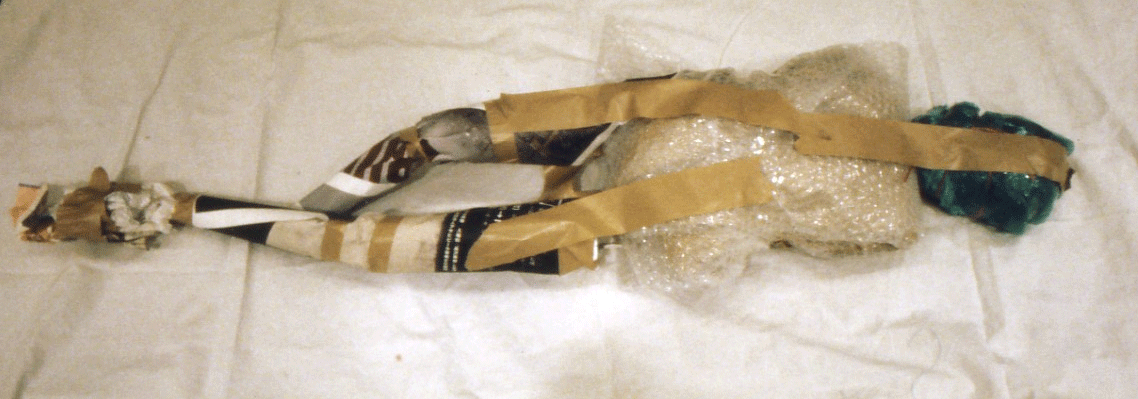
"Body Making" of 1/100, Magazine articles, tape, plastic, old newspapers. Art Tower Mito, 1994
In this same vein, our own "consciousness" experiences multiple realities simultaneously; this is expressed as "ubiquitous." In other words, it is a consciousness that is connected to everything. Therefore, "our own cells have precognitive abilities." However, "precognition" here does not mean seeing something that has already happened, but rather an intuition that discerns the immediate "intent" and "direction" of everything around us that relates to us. There is no self or other; everything is our own sense. There is no past, present, or future; everything is one "now." And it is changing.
The future is not determined in any sense. Because we discern the immediate "intent" and "direction" of everything around us that relates to us, the "future" is determined by the moment-by-moment choices of all "participants." Therefore, "every moment is not present, but present, attentive, and responsible." This is why actions, behaviors, and words occur. In other words, there is no moment, but rather, you are creating your own immediate reality, participating in and changing the collective consciousness' creation. Furthermore, even the most minute and subtle aspects of the universe play a part in the creative activity of "intelligence." Bring this fact to your mind with ease and ease, and focus on your breathing. Slowly, gently, lightly, and softly, with a mind that is free to play as you please.
*It is you who determines this. You virtually realize yourself in your own world. Each of your other selves has their own choices to make. Prophets in society create their own plots, their own worlds, stories, characters, and events as part of their doctrine, with the purpose of brainwashing humanity. You create your own world. Stories in which you are at the mercy of the prophet are written because you have been made to believe that you are part of that story. This is an example of the strength of belief at its finest. Have you noticed?
"Story" A Story Within A Story
2012 0605 1060 The essence of microorganisms is enzymes.
The emergence of living organisms is merely the result of an enzyme state. I view the existence of microorganisms as a "state," not a material entity. Human society is the same; countless people exist probabilistically, but their essence is merely a state, and individual existence is merely a result. This is a dialectical view of humanity. It is a holographic virtual image of light particles.
2012 0605 1059 Insurance, Pharmaceuticals, and Doctors:
A Trinity In the World?, insurance companies, pharmaceutical companies, and doctors are a trinity. Reports are gradually emerging that they are creating disease for their work. In fact, you yourself once played the role of a medical professional, killing many people. This world is a virtual one; observe it. If we apply this perspective to everything, the world will be a better place to live.
2012 0102 1019 You won't die?
You won't die. You are one with being. "Death" is a delusional concept created by humans, a brainwashing device that keeps livestock humans trapped in a prison of control. Our true essence is "spirit" and "immortal"—unborn and immortal. Matter, too, changes shape and nature, but it does not perish. Nothingness does not exist. Therefore, such artificial objects do not exist. Nikola Tesla's monologue: "The visible world is a delusion of the mind..." The mind is free to control itself.
2012 0102 1018 You are now a human being.
We are playing the role of a human being. Eternally, we are all one sacred being. Suffering is a fleeting experience in the process of becoming aware of a virtual pulse, a momentary experience in which we create a detailed program for ourselves, including our background and assignment, submit it to the Lord, and receive a contract. The result is the joy of learning about life, including the other, the ultimate.
2012 0102 1017 It is a manifestation of your inner intention.
God, yourself, or others are designs within your own mind. The intention is to awaken your own mastery within yourself. Discovering the secret to the mirror's mechanism. The purpose lies in the process of experiencing oneself as an alter ego. A simple experience would be neither meaningful nor interesting, so this epic space opera observes the awakening of an alter ego, a performer of all virtual realities, who deliberately makes it complex and repeats various trial and error processes.
2012 0102 1016 You Created the Universe
There is a man in India named Sai Baba, who claims to have created the universe. This phrase is meant to remind us that each and every one of us here today created the universe. I wrote "now" to refer to the present moment as you read this, and time is a contrived virtual sequence of images, a projection of grid pulses. The series of enigmatic images that fill the field of vision of the eyes fools us, causing us to mistake the reality of a theatrical film for the present.
2012 0101 1015 "Dreams in the Dream"
(Dream Theory), a term coined by Dogen.
Dreams are real as long as you are in them. While you are in a dream, it is a literal reality. While we are dreaming, electrical pulses that react to solid reality are embedded in our DNA. Even if we know, we forget. Repeatedly sending suggestive signals to the subconscious can send pulses of remembrance to the conscious mind. We use the power of belief to command our will. If you, reading this, are a slave receiving commands, it is you, the one who "makes the choice" to receive them, who commands.
2012 0101 1014 "Forget and Remember Yourself"
"Remember that you have forgotten yourself." You are more than an idea. What you think exists. Truly, in your heart, in faith, in God, everything is possible. However, even the tiniest bit of doubt, even 0.00001%, will prevent it from happening. This is the trick. Change by "deciding" to become 100% aware. Patiently command your consciousness every morning in your sleepy state. Your will "decides." Decide!
@Me_We_Me_We 2012
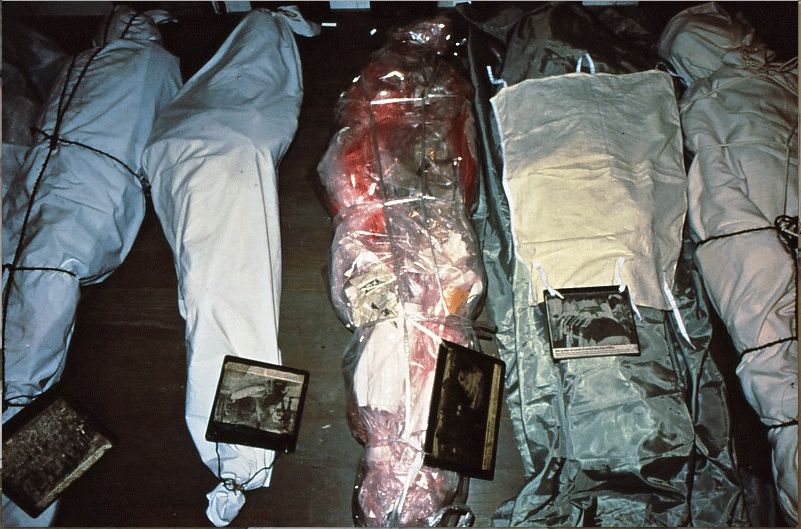
"5 Wrapps" Chalkboard, chalk, erasers, cloth, string, trash, papers, plastic. Art Tower Mito, 1994
2012 0101 1013 "Nothing exists without you."
"Nothing exists without you." Have you ever heard that? You created everything. Your imagination, the characters, the events, the detailed story, your spouse, your children, the people you dislike, your favorite events, the real movie sets, the movies, the virtual worlds, and even the negation of all of this.
2012 0101 1012 You created existence.
You, the self, imagined existence. Therefore...there can be no other being in your universe that negates you. That being in your universe exists solely to know itself. Nothing else is possible. Therefore, you, the self, are completely safe. You intended it to be for learning.
2012 0101 1011 "You in a Different Form"
"No matter what events you are involved in, you are not directly involved in them." "You, in a different form, are the ones who cause these events to occur in the universe, and your relationship with them appears."
2012 0101 1010 You are "the event."
You are "the ultimate embodiment." The illusion of God, the words he supposedly said, and whether you listen to them or ignore them are all of your own making. You can decide for yourself whether they are lies or truths. Japanese is a wonderful tool. The mind can also be read as God. Everything originates freely from within. Kotodama is a hint, and with application, infinite perspectives can be read.
2012 0101 1009 You are pretending to be "ignorant." Dependence on others is manipulation. More precisely, you are led to believe that you are being manipulated in this way. Imagine the mechanisms of pulse and action. Who speaks what you say, who receives it, who chooses and listens to it, and how you interpret it - all of this is up to you. You can choose not to choose. Not to see or hear. You can also choose to ignore. You.
2012 0101 1008 I've decided to "start over" countless times.
How you judge, what choices you make, and the conclusions you reach are all up to you. No one else can decide that. You are the one to choose. There are countless truths lined up. They are all lies. Once you know them, they disappear. Creation is imagination, they don't exist. Truth appears by chance and is chosen. So there's no need to choose? Huh?
2012 0101 1007 "Curious" - Choose with intuition.
It appears again and again. Zorome appears before and after. It begins to intrigue you. Things that require a choice come before and after. As long as there's no fear, your intuitive choice is not wrong.
2012 0101 1007 You Invented This World?
The outside world is filled with dogmatic traps lurking everywhere. Temptation is coming. Images, beautiful words, and judgment are overwhelmed by temptation. The pulse of freedom is twisted. Fear and threats are hidden in the words. Reject everything. It's all you made it.
@Me_We_Me_We 2012

"Making a Hundred Bodies" cardboard, articles, tape, plastic, papers. Art Tower Mito, 1994
2012 0101 1013 "Nothing exists without you."
"Nothing exists without you." Have you ever heard that? You created everything. Your imagination, the characters, the events, the detailed story, your spouse, your children, the people you dislike, your favorite events, the real movie sets, the movies, the virtual worlds, and even the negation of all of this.
2012 0101 1012 You created existence.
You, the self, imagined existence. Therefore...there can be no other being in your universe that negates you. That being in your universe exists solely to know itself. Nothing else is possible. Therefore, you, the self, are completely safe. You intended it to be for learning.
2012 0101 1011 "You in a Different Form"
"No matter what events you are involved in, you are not directly involved in them." "You, in a different form, are the ones who cause these events to occur in the universe, and your relationship with them appears."
2012 0101 1010 You are "the event."
You are "the ultimate embodiment." The illusion of God, the words he supposedly said, and whether you listen to them or ignore them are all of your own making. You can decide for yourself whether they are lies or truths. Japanese is a wonderful tool. The mind can also be read as God. Everything originates freely from within. Kotodama is a hint, and with application, infinite perspectives can be read.
2012 0101 1009 You are pretending to be "ignorant." Dependence on others is manipulation. More precisely, you are led to believe that you are being manipulated in this way. Imagine the mechanisms of pulse and action. Who speaks what you say, who receives it, who chooses and listens to it, and how you interpret it - all of this is up to you. You can choose not to choose. Not to see or hear. You can also choose to ignore. You.
2012 0101 1008 I've decided to "start over" countless times.
How you judge, what choices you make, and the conclusions you reach are all up to you. No one else can decide that. You are the one to choose. There are countless truths lined up. They are all lies. Once you know them, they disappear. Creation is imagination, they don't exist. Truth appears by chance and is chosen. So there's no need to choose? Huh?
2012 0101 1007 "Curious" - Choose with intuition.
It appears again and again. Zorome appears before and after. It begins to intrigue you. Things that require a choice come before and after. As long as there's no fear, your intuitive choice is not wrong.
2012 0101 1007 You Invented This World?
The outside world is filled with dogmatic traps lurking everywhere. Temptation is coming. Images, beautiful words, and judgment are overwhelmed by temptation. The pulse of freedom is twisted. Fear and threats are hidden in the words. Reject everything. It's all you made it.
@Me_We_Me_We 2012
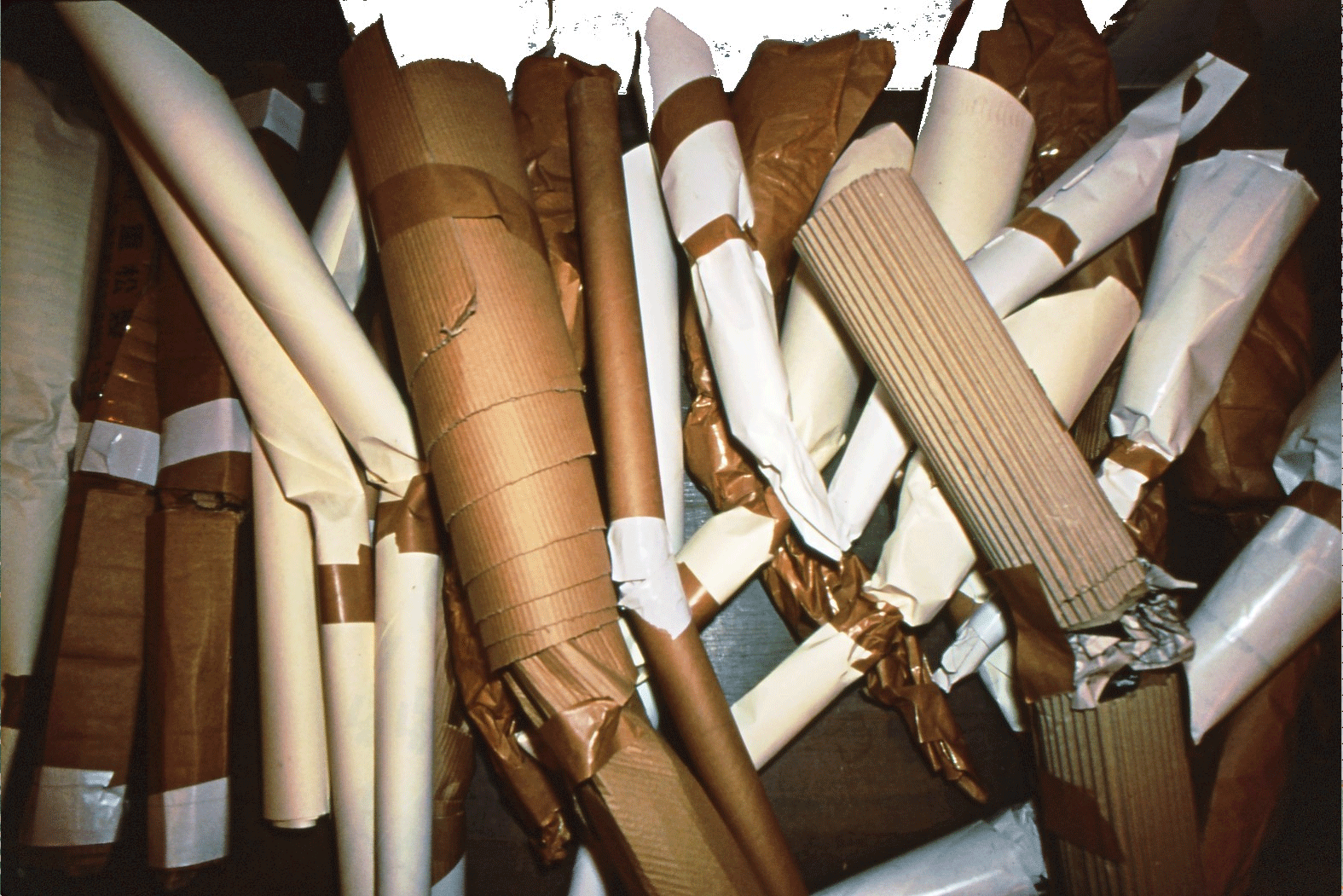
"Making a Hundred Bodies" cardboard, articles, tape, plastic, papers. Art Tower Mito, 1994
2012 0101 1006 The characters include others
in the role of belief. Because there are multiple characters, a huge number of others appear around you. They are the devices of the story you created, the backstage crew, the soldiers in the background. You wouldn't believe that. You wouldn't think you created that system to deceive yourself. These artificial humanoids are here to help you experience the true meaning of learning.
2012 0101 1005 You are the Almighty God.
You are everything endowed with exceptional wisdom. They have created and will continue to create all sorts of ever more complex systems, including adjustments, misperceptions, ambiguities, redoes, and rewrites, as well as countless possible variations that acknowledge the existence of such systems, doubt them, or even fail to notice or even rebel against them.
2012 0101 1004 Not only the characters, but also
the author of the story, those who criticize the author, the scholars, researchers, and analysts who consider them, and those who turn them into scripts and films. All of these are designers. The audience who observes them all is also part of their work. You are such a brilliant designer that you'd never even thought of such things. Even if you heard this, you would never realize it...
2012 0101 1003 And then I sent that clone to Earth.
Blocked my memory, I wondered who I was. However, as soon as I was reincarnated, I immediately forgot, searching for myself again, reincarnating again and again, unable to remember myself, and then reincarnating again and again, again and again, until finally, this time, I was able to reach a stage where I could remember myself. I cast myself as a character.
2012 0101 1002 Trapped in a trap of amnesia,
repeatedly reincarnated, forced to read a rewritten version of the Bible, the world's number one best-selling book, and brainwashed by a movie based on that same Bible story. Reacting to pulses of repentance, guilt, and fear, geometric shapes and vibrations that select beauty were coordinated, and pulses of sexual urges and appetite were implanted, rewriting my DNA.
2012 0101 1001 This is a staged expression,
used shortly before leaving third density. It's a cliché: at the next level, you are already completely free, so there's no need to wish for freedom. Yet, we realize that wishing for freedom is a contradiction. Wishing for freedom is a disciplined act of deliberately imprinting in our consciousness the conscious belief that we are not free. This is repeated in different eras, places, dimensions, and densities.
2012 0101 0929 Brainwashing through the use of language
is incredibly clever. The same birds of a feather, each ruling their own kind, emerge with new faces, new names, and new fields. The entire structure of the world, the workings of real society, school education, social structure, information culture, and even the use of language in the media (on television) are all intricately detailed and pervasive, and the vast purpose of brainwashing has been hidden throughout an incredibly long history.
2012 0101 0928 We decide? that the world we want?
will be like that, that we will make it that way. We imagine it. A world with a concrete image of such activities and construction will eventually come about. However, I had a dream in which I remembered something like this happening countless times in the past, for tens of thousands, hundreds of millions, perhaps even trillions of years.
@Me_We_Me_We 2012
"What's Up !"
Art Historian
In the universe, even "mass" and "ghosts" are reduced to perfection, fused, and neutralized. Even violence and death remain subject to the sole standard of vibrational influence. However, for those who are not directly affected by "daily life," the suffering of the numerous victims of, for example, inter-ethnic conflicts is impossible to recognize. These conflicts have occurred in all regions of the world since the end of the Cold War. This phenomenon of shared suffering is found to exist in Japan today. Yet, it is not true sharing.
Empathy—the conscious ability to experience the pain of others in one's own body, to imagine the same emotions in the face of the horror of death—isn't this always the first step toward creation, community, integration?
It is precisely this consciousness that Hiroshi Kariya animates his works. He carves the names of the karmas at the sites of genocide being perpetrated around the world onto black slate slabs, leaving traces. The karma of genocide may already be healed when it becomes a news article and when the article is clipped. However, by simultaneously recording and preserving it in a written form as his own sutra and scripture, Kariya attempts to turn this series of practices into a prayer to ease the pain tearing our planet apart today by physically experiencing and perceiving the gravity of the suffering. It is immortal because it is not something that "comes" from the outside world, but a system of all that continues "within the present."
Donaiyanen Exhibition Catalog French → English → Japanese
Omata Idemi Supplement
In a mediatized world, death and violence only have meaning in terms of the quantity and brutality of the images we receive. For example, the mass deaths caused by nationalistic conflicts around the world since the Cold War are not perceived as painful by people who are not "directly" affected by them on a daily basis. But isn't feeling the pain of others and sharing these feelings in defiance of the fear of death a step toward building a community? This is perhaps what Kariya Hiroshi is thinking. The countless examples of death from around the world written on a small blackboard are already mediatized in that they are newspaper clippings. Yet by writing them down in writing along with his own sutras, Kariya feels the pain firsthand, and attempts to turn this chain of actions into a prayer for healing the suffering currently plaguing the Earth.
The "now" without a future (an unhealable present) continues on and on.
In the end, is it possible to imagine the passage of time and death without relying on the representation of the other side or a transcendental dimension? What, exactly, can we share with others about pain and death? Can we objectively acknowledge and accept negative elements like pain, ugliness, and suffering within our collective lives? Perhaps only by asking such questions can we find a way out.
Donaiyanen Exhibition Catalog (Japanese) 2, p. 107
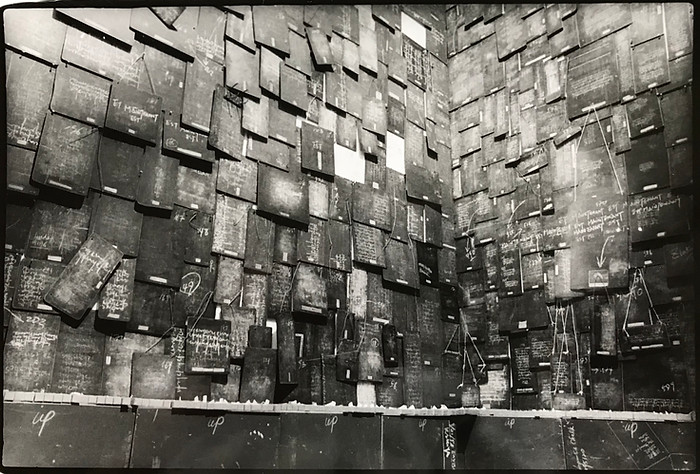
1,083 chalkboards, fossil chalk, erasers, storage boxes, string, wire, ENSBA, Paris, 1998
Photo by Bernd Jansen
"Now What's Up !"
Curator, Collection Lambert
In the 1960s, On Kawara invented his "date paintings," an expression of double temporality. His painted canvases could remain dormant in their boxes or be "revitalized" simply by being exposed to the wall. At the bottom of the packaging, the artist leaves a newspaper clipping corresponding to the date the canvas was attached. While we are experiencing world events, an abstract cosmic time exists there.
Hiroshi Kariya's method is the reverse process. He accumulates history, sometimes just the title, cutting out and pasting global events from newspapers and pasting these words onto school blackboard slate. On the reverse side, he writes small sentences in white chalk, which inevitably fade over time. "Now is the now is the now..." This statement remains a lifelong motif in all of his work. He chose to live in New York for many years, and like other immigrants, he is concerned not only with the problems of his own country, but also with all the dramas that are plaguing the world, far beyond island to island and border to border.
If we speak of a certain empathy that better understands his work, he sees it as embracing and taking on all the evils of the earth. The elaboration of his installation, which he installed in March, and its theatrical landscape of stacked slates, contain clear references to the historical religions of Japan, Shinto, and Buddhism: in the alleys leading to the mountain temple, there are piles of wishes and prayers inscribed on thin boards, reminiscent of votive plaques, or pieces of paper tied to wooden boards or maple branches. Having left his home country, he finds great meaning in the memories he collects and resurrects, feelings that will never be looked back on.
For him, Kobe was a double drama: the collapse of the entire Japanese system and the lack of social cohesion for the various minorities forgotten in this catastrophe. Thus, through his scriptures, which slate over time, he portrays his country's contemporary dramas—all those pointless deaths: the Israeli-Palestinian conflict, political prisoners in Africa, the destruction of Sarajevo, or the Oklahoma City bombings—and, like On Kawara, the artist relativizes the very idea of temporality and globalized information, even if the principles are reversed.
(Incidentally, On Kawara and Hiroshi Kariya were friends even before his first solo exhibition, and appear in On Kawara's "I Met" series.)
Donaiyanen Exhibition Catalog (French → English → Japanese), p. 152
1997
I am still writing the "The now is"
I am still thinking about it, simultaneously.
1997
Exhibition review of "The now is" by Takashi Kitaoji and Hiroshi Kariya, "1996 Sutra"
If someone without prior knowledge were to visit the gallery in the afternoon, they would probably not be able to read the words "The now is" written all over the blackboard, and would probably understand it to be in a vaguely unknown foreign language from the 1996 newspaper clippings (about the tragedies in Bosnia, Rwanda, etc.) pasted on the back of the board. So why is this blackboard here? If I asked him, "Are these the ruins of Sarajevo?" he probably wouldn't answer "yes."
In other words, the ruins placed here leave one speechless.
"There is only one thing here, and that everything else exists simultaneously." (Quote: Hiroshi Kariya)
One that exists simultaneously

"Parallel Landscapes" Installation, Mizuma Art Gallery, 1997
Floor: chalkboard, plaster, chalk, eraser, easel, gauze, data affixed on the back.
Wall: Framed chalkboard, newspaper articles affixed to the back, hinges.
Parallel Concepts
Here is one thing:
Existing simultaneously with everything else:
Your breathing and my breathing are parallel:
My breathing and your life are parallel:
The clouds move, and we all move in parallel:
Our breathing moves the sun in parallel:
Writing "the now is" in parallel:
Consciousness and this writing are parallel:
Unconsciousness and breathing are in parallel:
Here "the now is" and elsewhere "the now is" are parallel:
The erasure of chalk and the bugs in my garden are parallel:
The rising sun and the dust on my table are parallel:
Affirmation, ignorance, denial, and indifference are parallel:
Hiroshi Kariya, 1977, 1987, 1997, 2007, 2017
1996
Planting the seed of an idea in the here and now
“...Kariya writes “The now is sutra” on both sides of a dried bean, going through about 100 beans every night before going to bed...with notes of his daily thoughts… Based in Brooklyn, N.Y., his open poem was first in English;
One piece of Brahma Day
One piece of “the now is”
One piece of 8,640,000,000 years
104 pieces”,
Miki Miyatake, The Japan Times, 5.1, 1996
1996
I am still reading ‘The New York Times’;
in different date, in different name, in different place, in different print.
I am still reading ‘The New York Times’; in different words, in different pictures, in different stories.
I am still reading ‘The New York Times’; in different titles, in different times, in different killings.
“1996 Sutra”; (news title sutra), typed on paper, 1996
Words are “produced and exist, so also our presence that the world has existed”, yet I could live without it.
If you have observe the detail of Kariya’s “Chalkboard Sutra”, you will recognize that the writing on this work is not freshly written but layered, written and erased over and over. The chalkboard as media; writing on a
whitish half-clear surface, as it is difficult to erase previously written words perfectly. I think everyone recalls, with this sort of chalkboard image, the memory of school life in childhood.
“Chalkboard; 10 Years later, Chernobyl”
acrylic on masonite+chalk+eraser, collage on reverse side, 1996
Planting The Seed

“Chalk writing of “∑ 139+89 words”, and placing a daily work of “Seed sutra”, Mizuma Art, Tokyo, 1996
To enter the gallery floor is my chalkboard. My foot to enter. My hand to chalk proceed my life.
To enter this life. To proceed my chalk writing. To exit my writing, to proceed my writing to erase.
I am chalk.
I am an eraser.
I am a chalkboard.
Hiroshi Kariya
“Chalk writing of “∑ 139+89 words”, and placing a daily work of “Seed sutra”, Mizuma Art, Tokyo, 1996
1996
“The concept of ‘making’ as a Buddhist theory of composition...His creation, as well as destruction of visual form; It begins with a concept, that works through his body using feet and hands, and ends with an incredible sight of beauty on the gallery floor... his endless ”the now is” writing...”,
Toshihiko Washio Komei newspaper, 5.15, 1996
1996
“innumerable ‘the now is’ writings in chalk, lead us to another dimension… while you are focusing on the spiral writing,...soon you begin to notice the gallery space transforming into the metaphysical field; from ordinary concrete floor to an aged ancient granite rock, and the wall begin moving away out of sight”
Akio Sagegami, Shodoh Kai magazine, July, 1996

Reading Candle Lightings curved on candle1995
Reading Candle Lightings
“the now is” reading
“the now is” writing
“the now is” lighting
“the now is” melting
Reading Candle Writings
curved on candle, 1995, photo; Hideki Hiromoto
I am still writing “the now is”
I am still writing “the now is”
I am still writing “the now is”
1996
“Gallery”, weekly magazine PIA, 4.30
1995
A.M. Weaver “Hiroshi Kariya’s installation
‘No man is free who is not master of himself’ is a grand crescendo. His chalk board writings, collages and wrapped forms are crowded into a prison-like enclosure… Kariya’s construction attempts to engage the viewer by challenging the perception of prison; here the prison is the self, the mind, systems and world conditions...”
A.M. Weaver , Painted Bride Art Center, catalog essay
1995
Hiroshi Kariya’s “No Man Is Free Who Is Not Master Of Himself” EPICTETUS
is a grand crescendo. His chalk board writings, collages, and wrapped forms are crowded into a prison-like enclosure. (Kariya quote: this is a small scale of our 3D-physically-informed world, we are the prisoner)
Each item, material and mark alludes to a complex matrix of events, activities, public and private and world conditions. No Man Is Free Who Is Not Master Of Himself is a continuum of a work created in 1993. Sign of the Times, Kariya’s installations evolve and flow like a river from one piece to another. An integral part of his process is to compile layer upon layer of data, building each project by expanding or editing depending on time and space.
A. M. Weaver, Curator, Painted Bride Art Center, Philadelphia PA, USA
1995
NO MAN IS FREE WHO IS NOT MASTER OF HIMSELF
-EPICTETOS-
Installation:What is the prison?
3 The prison is your world,
2 The prison is your nation,
1 The prison is your border,
0 The prison is your religion,
9 The prison is your hierarchy,
8 The prison is your system,
7 The prison is your program,
6 The prison is your classroom,
5 The prison is your choices,
4 The prison is your believe,
3 The prison is your thoughts,
2 The prison is your physicality,
1 The prison is your consciousness,
“13 wrapped bodies lie on the floor inside the prison. Beneath them, the floor is covered with 1000 multisided, chalk writing covered chalkboards. They are individually chalk board is attached with collaged newspaper clippings of our social news articles, and or erased surface. Erasers and chalkboard are randomly placed.”
Large version of 4 installations was originally installed in 1994, at the Art Tower Mito, Ibaraki and Mizuma Art Gallery, Tokyo, Japan, under the title “Sign of the times”.
Painted Bride Art Center, Philadelphia, Penn. USA
Hiroshi Kariya, 1995, Catalog Essay
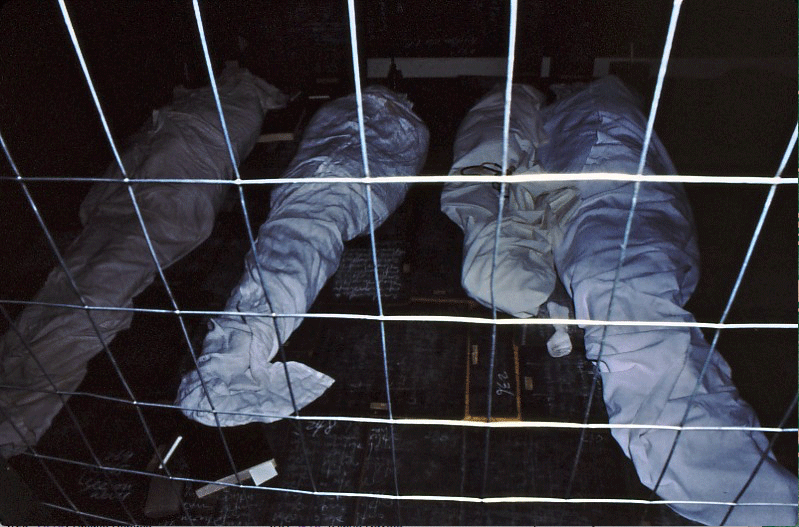
"No Man Is Free Who Is Not Master Of Himself" 13 body wraps, scrap materials, canvas, cotton, wire, wood, blackboard, blackboard eraser, chalk writing, Painted Bride Art Center, PA, 1995
The Prison Is Your Choices
1995
Toshihiko Washio “Kariya is trying to capture ‘Time’ by means of his symbols which appear and disappear. Without their emergence, ‘Time’ exists only in an undisturbed limbo...However, if none exists, no sign appears..the meaning in his writing of “the now is” expands to an extraordinary dimension..”
Toshihiko Washio , Art Journal, magazine, July
1995
Tsunaki Kuresawa “Chalkboard Sutra with combined element, chalkboard, chalk and eraser as one unit...as composition of our world...Each chalkboard is marked with writings or erasing of his ‘the now is sutra’. The phrase is an index which points to every moment of “now”… a meaning extends, at the same time, to the unascertained existence of eternity...”
Tsunaki Kuresawa , monthly art magazine BT, Sept.
1995
Hideki Nakamura “Art as representation of today’s mental structure”,
Hideki Nakamura, monthly art magazine BT, June
1995
“..by using discarded objects to rebuild‘Time’”,
Monthly Gallery, magazine, June
1995
Tamaki Harada “the work is a healing art. His writing of ‘the now is the now is..’ strikes us very deeply to heart.”
Monthly magazine CAZ, 6.27
1995
Taiji Yamaguchi “small chalkboards each the size of a magazine, similar to a memorial tablet,.. each chalkboard framed in gilt rests on its gilded chalk ledge..the surface layered with repetition of his ‘ the now is sutra’ writing and erasing.”
Taiji Yamaguchi , Akahata newspaper, 6.23
1995
Toshihiko Washio “Striking at first, then a moment of serenity washed over me..He is performing a memorial service; producing a monument dedicated to every moment by infixing his sutra on the surface of the chalkboards...”,
Toshihiko Washio, Kohmei newspaper, 6.23
1994
“Writing on Chalkboard exists with the intention of being erased. Written exclusively by hand, it stresses the existence of life. Words are ‘produced and exist, so also our presence that the world has existed”. Once they appear, they vanish quickly. These works are deeply connected with the writer’s movement of hands, body and voice in front of chalkboard; the writing and this activity becomes one. On the surface, Writing on Chalkboard
holds the presence of “now”, it reveals the artist’s voice and performance.
A classroom is a mysterious place where fundamental and universal truths are revealed, where a teacher’s total life experience is exposed.
As I have already mentioned, Writing on Chalkboard does not become invisible, but remains as sheer traces even though they are erased. Through erasing they simultaneously create a background of new writing. This
system is quite similar to human life, isn’s it ? As someone dies, their trace as karma will harmonize with the whole, and forms the background of new life.
I believe that one of the most interesting ideas in Kariya’s work is the fact that he has connected the notion of copying the sutras into Writing on Chalkboard.
In copying sutra, the writer’s life is settled on the paper by written words, which will last for a very long time. Kariya transferred this process from paper to chalkboard and succeeded in showing a momentary and instantaneous side of life. The chalkboard writing expresses a collective “voice” of today’s humanity as if it were one loud scream. In this stage Kariya’s installation is a classroom, yet, at the same time, could be a prison, a barracks or an abandoned house where graffiti/scribbling is found on the walls...
Yasushi Kurabayashi, “Sign of The Times”, Mizuma Art Gallery, catalog
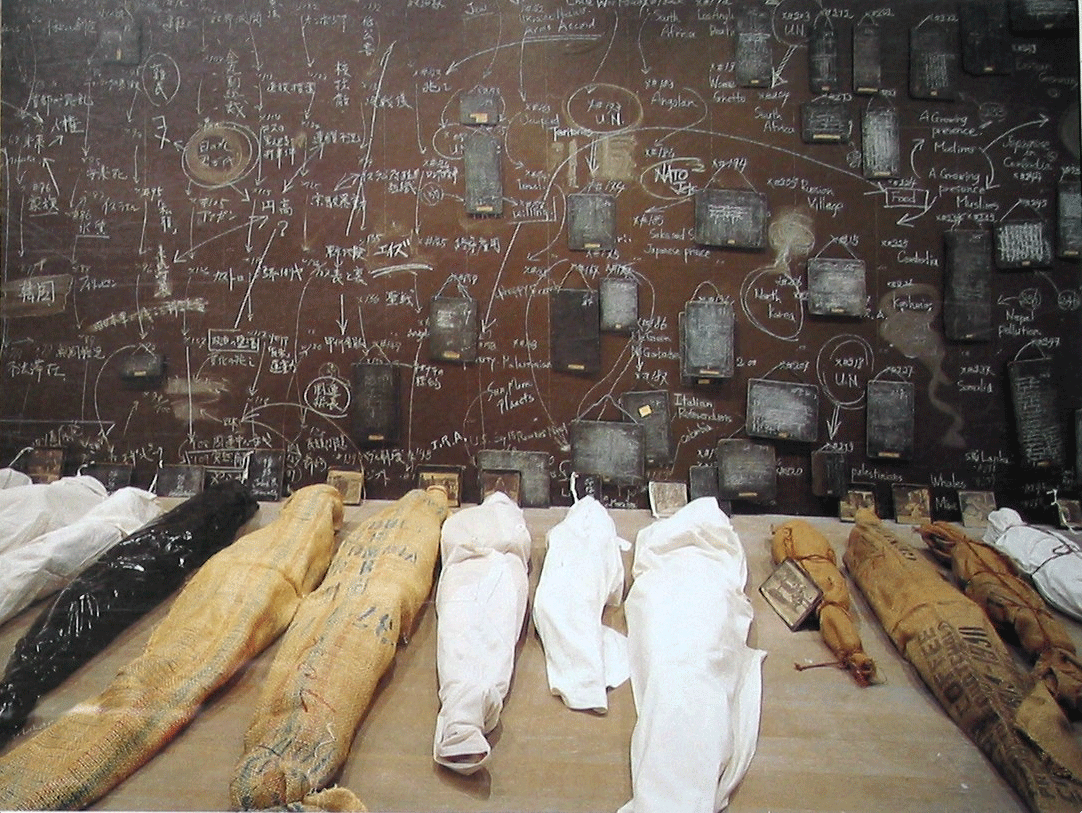
"A Wall of Bosnia: A Hundred Wrapped Objects Lined Up on the Floor" Chalkboard, chalk, eraser, cloth, Art Tower Mito, 1994, photo: Taku Saiki
Unusual Simulation Art
human figures wrapped bodies attached with many small chalkboard, and written topics from the daily newspaper
1994
Yasushi Kurabayashi “Kariya’s work is an action complete unto itself with its own complete meaning...Kariya’s work does not present a world situation that is looked at ‘objectively.’ Instead he strives to grasp the world as a whole, including his existence...”
Yasushi Kurabayashi, “Open System”, Art Tower Mito, catalog
1994
Seiichi Watanabe “...The end of life, the cessation of a national system or ideology are all influenced by a sense of termination...Today, have many artists experienced or claim that the horrors of termination are inevitable ?...”
Seiichi Watanabe, “Open System”, Art Tower Mito, catalog
1994
Akio Sagegami “..the expression of his work is in his writing, more specifically, the sutra
writing, which he has simply named ‘SUTRA’ ; the string to connect everything from dust
to debris as one organic living unit...”,
Akio Sagegami, Shodoh Kai, magazine, Aug.
1994
“Installation...his grid (the axis of co-ordinates) drawing on the gallery wall and floor along with placement of the flowers, chalkboards, candles, and the white cloths of fragments... relating to the work at Art Tower Mito’s gallery wall...”
Nikkei Art, magazine, July
1994
“It was shocking ...Kariya’s work...100 wrapped dead bodies, Collapsed girl and vulture waited...questioned us in what is the real beauty ?...”
Gallery, magazine, July
1994
“Kariya’s life work theme; ‘What I'm writing is the now is what the existence is "the now is" writing is.
Nikkei Art, magazine, July
What I'm writing here is the now is what the existence is "the now is" writing is.
1994
“Open System as ‘94 Mito Annual...”
Artist, magazine, Taipei, June
1994
Junichi Konuma “Strong and powerful, Kariya exhibits material as historical evidence and proof of its preexistence”,
Junichi Konuma, monthly art magazine BT, June
1994
Tamaki Harada “Every event of the world is connected to our time in ‘The now is’”
Tamaki Harada, CAZ, magazine, 5.25
1994
“as many as 100 human figure objects, wrapped in white cloth, Kariya’s caustic statement on ‘WAR’...”,
Asahi shinbun, newspaper, 5.12
1994
“Installation, Hiroshi Kariya’s The class room with labyrinth’ expresses our today’s world.”, Art Tower Mito, Mito Annual 1994, 4 artist were selected for this year.
NHK TV video Sunday Review, 5.8
1994
“Sign of the times...Hiroshi Kariya, a N.Y.-based sculpture and art journalist, records words from articles in the news and in journals on tiny blackboards. His installation of 1083 pieces plays up the ridiculous repetition of life’s events.”
Tokyo Time Out, May
1994
Chie Kaihotsu “human figures wrapped bodies attached with many small chalkboard, and written topics from the daily newspaper. It seems like an unusual simulation art, but every detail of work is related to his concept; ‘Sutra’”
Chie Kaihotsu, Studio Voice, May
1994
“Expression of spirit as open- minded in ‘94 Mito Annual”,
CLIQUE, magazine, 5.5
1994
Ryoko Hirabayashi “...to guide art for a higher level of system”,
Ryoko Hirabayashi , Elle Japon, magazine, 5.5
1994
“His work examines the sign of the times, with his unique work; Journalistic Painting, Sculpture’”
Geijutsu Kohron, magazine, May
1994
Tamaki Harada “Our world exists as humanity does all on the same plane, at the same time,
they are all connected in one by ‘Karma’”,
Tamaki Harada, City road, April/May
1994
“Kariya who lives and works in New York City, picks up the daily topics from the newspaper, then he copies the titles on the chalkboard...repetition of his writing as much as our world events repeat... as his sutra copying...”
PIA, weekly magazine, 4.26
newspaper, he copies the daily titles on the chalkboard, repetition of his writing as much as our world events repeat
1994
“Sign of the times; monument of the world’s events Year 1993”
Iwate Broadcasting TV News, 4.26
1994
Tsutomu Shimoda “...discarded object as a reference to our Karma”,
Iwate Nippo, newspaper, 4.23
1994
Taiji Yamaguchi, “...floor filled with an enormous amount of writings in chalk, an installation, you walk on to”,
Akahata, newspaper, 4.22
1994
Dylana Accolla “Kariya’s powerful Boltanski like monument to war dead is a caustic statement on international diplomatic hypocrisy that contributes to the deaths of thousands of people every year...”
Dylana Accolla , Asahi Evening News, 4.21
1994
Miki Miyatake “Kariya believes that the dead do not vanish from the universe but are present somewhere. To acknowledge their existence, Kariya did a performance that included chalking the topics of his pieces-places of conflicts, oppressed peoples and social problems-on the stone floor of the museum balcony, while those present offered red roses and candles along with their silent prayers....His writing is a confirmation of his life: He writes on air by breathing and on water by drinking...”
Miki Miyatake, The Japan Times, newspaper, 4.17
1994
Tamaki Harada “Open System-Art.. as sutra copying, he picks up-dated topics from daily newspaper, and copies on the discarded objects..Then, he assembles them, and finally he exhibits on the wall, this expression appears as a prayer to the world and for the human races”,
Mainichi Graph, weekly magazine, 4.17
1994
“There is a room filled with work; ‘Gate of Bandages’, ‘World’s Wall (Torn Bosnia)’, ‘ Turk’s Window’, through ‘Wrapped Bodies’, ‘Bloody Stretcher’, and ‘Sand Bags Wall’, laying on the floor while writings on the chalkboards were hung on the wall..”
Ibaraki newspaper, 4.6
1994
“Kariya’s performance; 100 bouquet,Candle light, Chalk writing...”
Shin Ibaraki Shinbun, newspaper, 4.2
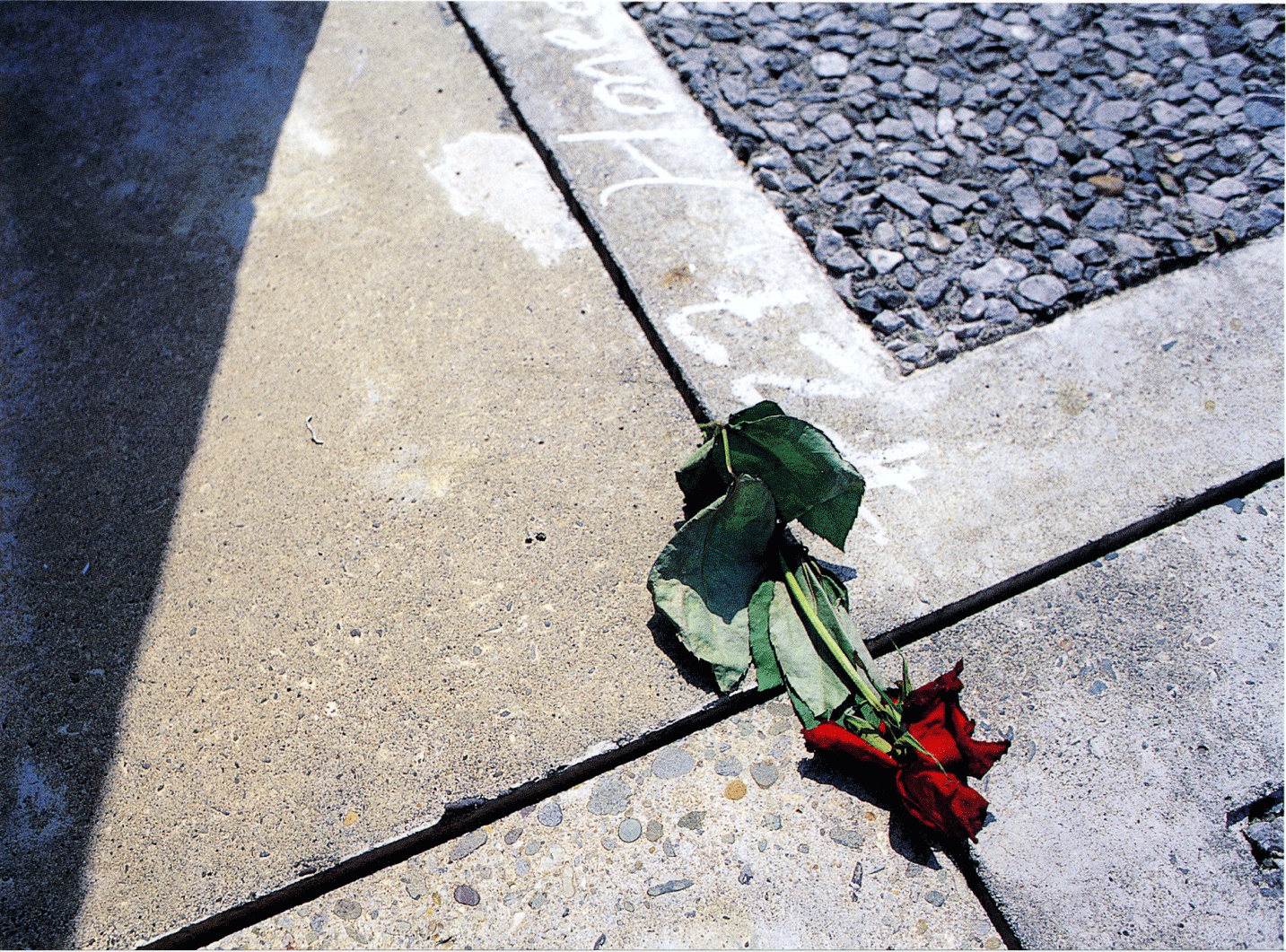
"100 Flowers, Candles, and Chalk Titles" - A minute of pseudo-silence was dedicated to the spirit of the subject matter that inspired the work, followed by the offering of flowers, candles, and the writing of the title in chalk. Performance with the audience on the terrace of Art Tower Mito. Art Tower Mito, April 2, 1994
To the spirit of the subject matter; inspired the work, offering of flowers, candles, and Chalk Titles
1994
“Mito Annual ‘94”
Shin Ibaraki Shinbun, newspaper, 4.1
1994
Previews “Will Closed Art be opened ?”
Art News, Japan, April
1994
Yasushi Kurabayashi “Conceptual”
Prints 21, magazine, winter
1994
Yukiko Shikata “Open System”
World Art, magazine, Autumn
1993
“In Memory of 1992”, catalog, Spark Gallery II, April
1993
“Fax from New York; article of Kamaishi’s life-long employment policy,... in New York Time’s front page...”
Katsuhiko Sato , Kahoku Shinpo, newspaper, 5.12, 1993
1993
Katsuhiko Sato “Kariya expresses poverty and war victims as ‘used and useless’ by using discarded objects in his art...What can we do with the limited; nature, resources, city, and human...”
Katsuhiko Sato, Kamaishi Shinpo, newspaper, 5.11, 1993
1993
Hiroshi Kariya “Tale of Sutra; 9 episodes”,
Hiroshi Kariya, Kamaishi Shimpo, newspaper, May/June
1993
“...regarding New York Times’s article about Kamaishi as an example of ‘City as a resource’..What we have done to the city and human was consumption then abandonment...because of past mistakes...Fax from Hiroshi Kariya...”
Katsuhiko Sato, Kamaishi Shinpo, newspaper, 5.4, 1993
one single unit in everything; organic matter, time, space, and events; everything in one single unit
1993
Hiroshi Kariya “What is here, is one thing; that is everything, including organic matter, time, space, and events
which become one single unit... nothing exists apart from that. My work of art: its expression, activity, and our life’s form are on the same plane”,
Nikkei Image Climate Forecast, May, 1993
1993
“Mourning in 1992...” Art Now Japan, Mar./Apr.
1993
“Gallery”, PIA, weekly magazine, 3.30
1993
“As journalist’s report, Kariya exhibits today’s wounded world; Somalia, Bosnia, AIDS... in his Art: Journalistic sculpture/ painting”
Asahi, weekly magazine, 3.12
1993
“In memory of 1992, includes 18 wrapped bodies..”,
AERA, Asahi Shimbun Weekly, 3.30, 1993
1993
“The Year 1992: as journalist, Kariya shows the sadness of our world in his ‘In memory of 1992’”,
APO, biweekly magazine, 3.18, 1993
1993
Katsuhiko Sato “...will we also become the discarded object,... in the near future ?
The discarded object: it was useful, but now useless. We live, and die... a reference to his mother’s death, Kariya exhibits illness and sadness of our today’s wounded world in his ‘In memory of 1992’”,
Katsuhiko Sato, Kamaishi Shimpo, newspaper, 2.26,1993
1993
415 Chalkboard Installation, 415 Palestinians
“Peace Before Land” Rabin
“Land Before Peace” Assad
Hiroshi Kariya, In Memory of 1992, Spark Gallery II, Tokyo
1990
“ICA represents thousands of sutra, by Hiroshi Kariya”,
Penn Life, news, Phil., 3.8, 1990
“Sutra Tomb”, ICA Philadelphia, 1990
1990
“Memory: Ilya Kabakov’s wall”, ICA Philadelphia, 1990
1990
“Kariya illustrates the principle of the sutra by linking his installation with those of ICA’s
past. He recycles walls used in a recent exhibition by Ilya Kabakov,...”,
University City Review, weekly news, Philadelphia., 3.2, 1990
1990
“1 Piece = $1 bill cash = 1 person’s only; No other bill is accepted.
Hiroshi Kariya, 800 Kabakov’s wall fragment”, ICA Philadelphia, 1990
1990
“8000 Years Spring, 8000 Years Autumn”, ICA Philadelphia, 1990
1990
Edward J. Sozanski “Contemplating, Creation, Rebirth...It attempts to stimulate
in the observer a higher consciousness akin to a state of grace,..far from an outstanding objective...installation represents a prolonged act of meditation on immortality...the process of making it...is more consequential than the artifacts it produces. It is, in fact its essence... search for communion with a cosmic unity.”
Edward J. Sozanski, The Philadelphia Inquirer, newspaper, 3.18


Above: Exhibited at Ihara Ludens Gallery, NYC, 1990
Below: I Ching: 00 000 1011 1010 1010 1001 000 00 Record of "Eight Symmetrical Results in a Day"
The time of day and the hour of creation are coded with the structure pieces of wood, combined with the I Ching code. Kariya's "the now is" written in the sutra and traces of Sanskrit learning mixed in. A day is divided into 24 hours. When multiple hexagrams appear in a day, the dimensions of the parts shrink. A mixed technique of combining numerical sequences. Acrylic on pine wood, with the date, time and hexagram branded on the back. Maximum size is 24x16 inches. The pieces are displayed stacked on bottom support piece.
1990
“ICA represents thousands of sutra, by Hiroshi Kariya”,
Penn Life, news, Phil., 3.8, 1990
1990
“Sutra Tomb”, ICA Philadelphia, 1990
1990
“Memory: Ilya Kabakov’s wall”, ICA Philadelphia, 1990
1990
“Kariya illustrates the principle of the sutra by linking his installation with those of ICA’s
past. He recycles walls used in a recent exhibition by Ilya Kabakov,...”,
University City Review, weekly news, Philadelphia., 3.2, 1990
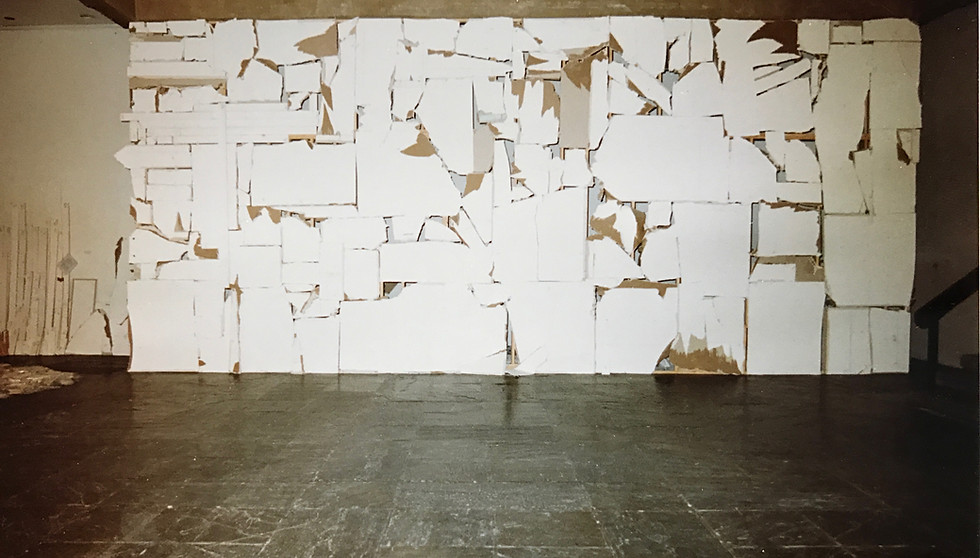
"Memory: Ilya Kabakov's Wall." Plaster, plaster, wood, screws, nails, glass bottles, trash, debris, etc. All fragments numbered. ICA Philadelphia, 1990
Roots Of Thought
16
Kabakov's materials shall be numbered, sealed in a plastic bag,
and sold to the public for a purchase price of a single dollar bill only
3
Ilya Kabakov's wall shall be destroyed.
7
Kabakov's wall materials shall be saved; the world's natural resources problem shall be reflected in the work.
9
Kabakov's materials shall be marked identify their origin.

"RECYCLE FOR THE BETTER TOMORROW' stamp, 3"øx3", wood
limited to one piece per person. All profits shall be used for purchasing new installation

"800 Kabakov Fragment" issued for 1 person, 1 piece, 1 $ bill only edition

"1 Doller Kabakov Wall Fragment" sales record by ICA official workers, 1990
1990
“8000 Years Spring, 8000 Years Autumn”, ICA Philadelphia, 1990
1990
Edward J. Sozanski “Contemplating, Creation, Rebirth...It attempts to stimulate
in the observer a higher consciousness akin to a state of grace,..far from an outstanding objective...installation represents a prolonged act of meditation on immortality...the process of making it...is more consequential than the artifacts it produces. It is, in fact its essence... search for communion with a cosmic unity.”
Edward J. Sozanski, The Philadelphia Inquirer, newspaper, 3.18
1990
Robin Rice “Still breathing, still thinking,...Kariya’s work...an ‘ordering’ activity that is being recorded, and that activity is a spiritual end in itself.”
Robin Rice , Philadelphia City Paper, newspaper, 6.22, 1990
1990
Sutra
One Thing In Everything: Everything In One Thing
14
The work is dedicated to the anonymous, unknown,
abandoned, buried, used, useless, ugly, forgotten, and dead.
19
18
Everything not included here should not be excluded.
13
I'm a paragraph. Click here to add your own text and edit me. It's easy.
Sprout.
This would not exist without Gorvachev, the Berlin Wall,
and New York Sanitation.
1
Indexing is Energy
1989
“Begins and ends” curved stump, ink, plumb pointing the core stump, Exit Art, 1989
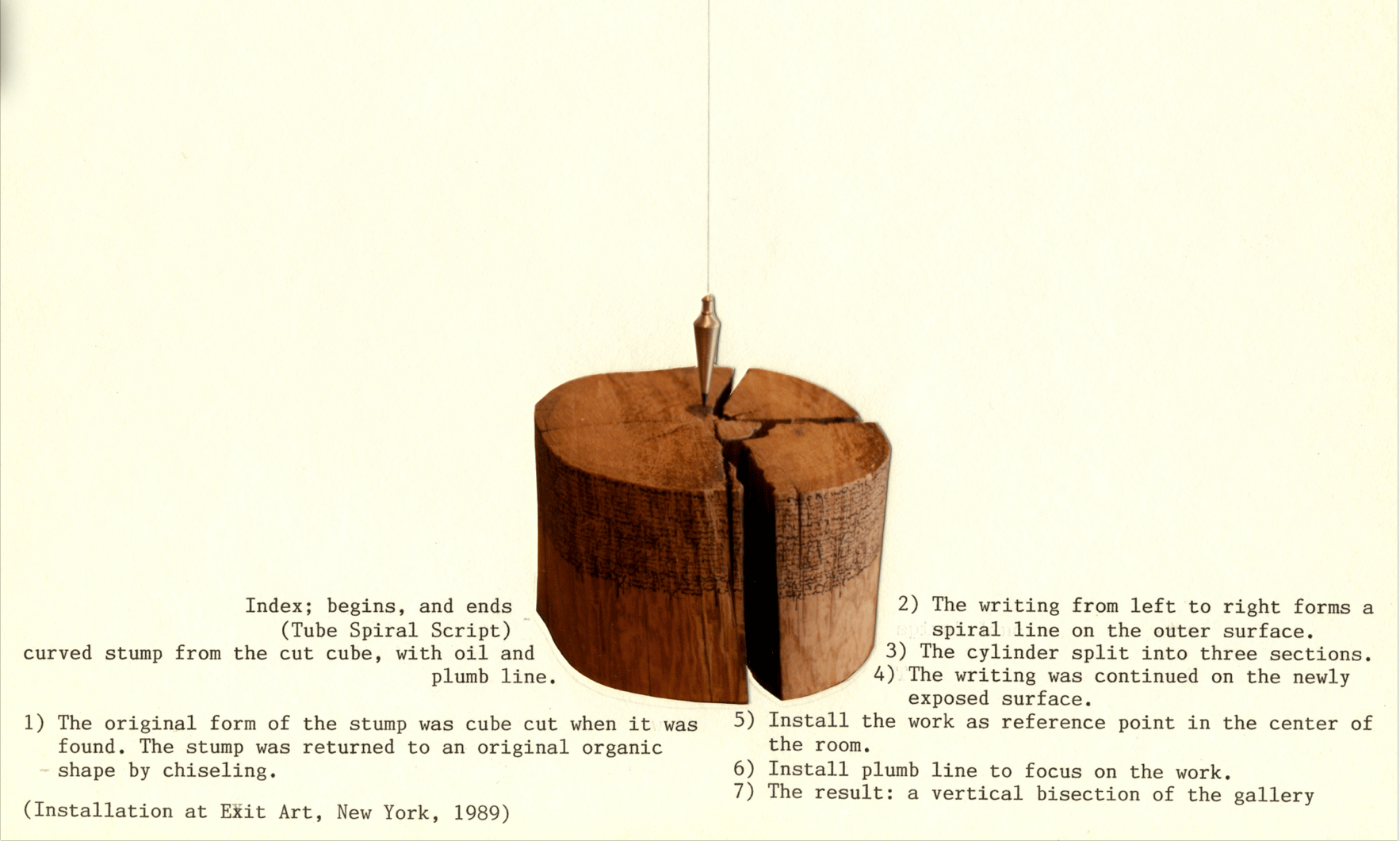
"Begins and Ends" Ink on peeled tree stump, and plumb pointing the center of the gallery, core stump, and the earth, Exit Art, 1989
Thought Is Energy.
1989
“I-ching chance hexagram, the choice, the chance, the change, the season, the period, the symbol”
1989
“the image, the title, the word”
1989
Kunie Sugiura “the work is entitled ‘Sutra’ . This title refers as searching for the meaning
of existence, and is a study in the concept of infinity..”,
Kunie Sugiura, BT, monthly art magazine, July
Words alone have no meaning. Existence does not speak for itself. A kinetic energy arises that integrates these two concepts, and "it" expresses "being" and "thing." A creative method is developed based on form and structure that explains these three concepts. Paradoxically, a creative principle is developed that reflects the autoarchaeological creative principle that asks, "How was the form of a created object, or an existing object, created in this world?" through the trial-and-error process of creation.
An example of one creative concept
The work is a composite of three functions:
(1) to affirm the writing a s generative force.
(2) to produce a *ruler to measure the writing.
(3) to recall, on the surface: the form of sutra.
*language verse by which to gauge or describe symbolic forms.
This could be by ruler, structure, materials, system, rather than writing.
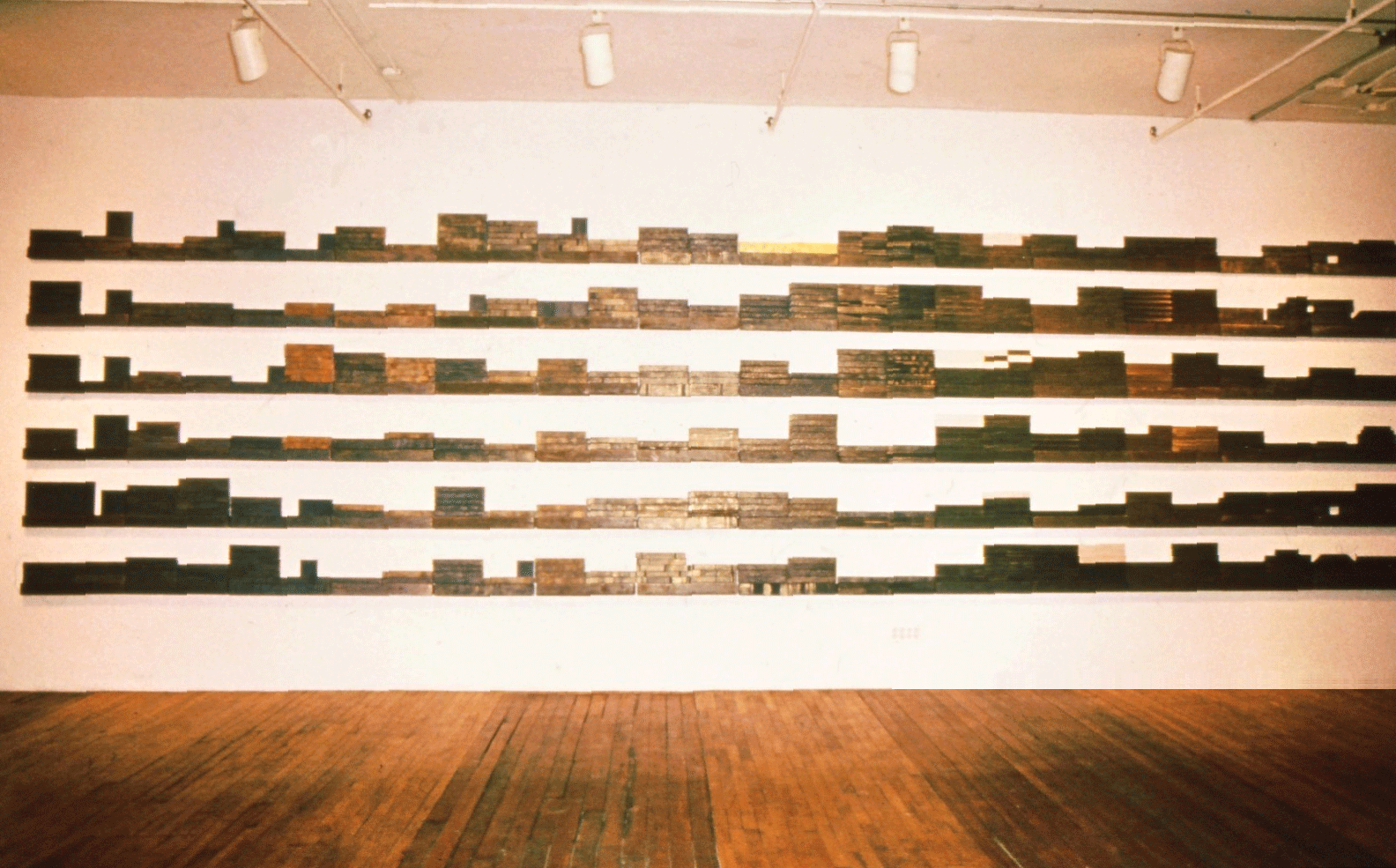
"8000 Years of Spring, 8000 Years of Autumn," acrylic on wood, Exit Art, 1989
1989
9 Spells
Indexing Is Energy.
Thought Is Energy.
Awareness Is Energy.
Seeing Is Energy.
Intention Is Energy.
The Is Energy.
Now Is Energy.
Is-Be Is Energy.
Writing Is Energy.
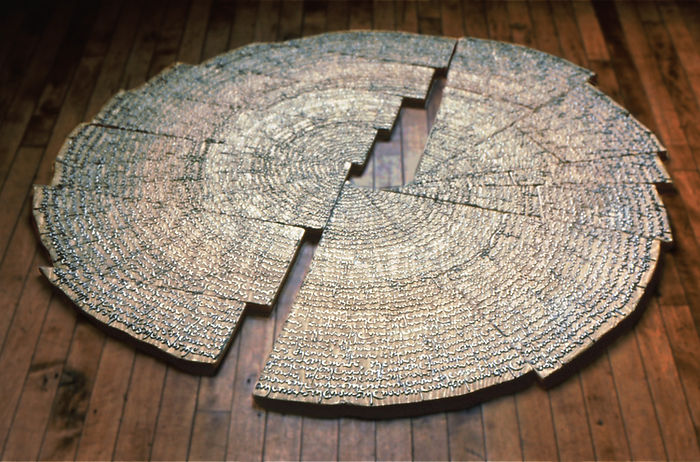
"One Piece Made of 33 Fragments," acrylic on wood, Exit Art, 1989
1989年
3 From the now all proceed
In the now all exist
and to the now all return
2 This is the now, that is the now,
From the now the now has come
The now remains the same
The now subtracted
from the now results in the now
4 The now is here
The now is there
It is near and it is far
It is inside of all this
and it is outside of all this
All beings in the now
and the now in all beings
1 “What is the now ?”
“Whence has the now come ?”
“Where the now going ?”
5 The now is all this, and again
Hiroshi Kariya, Recreation from the text by Upanishad, 1989
One thing in thirty-four words: thirty-four words in one phrase: one phrase in thirty-four changes
29 words in 1 phrase: 1 phrase in 29 things: 29 things in 1 work
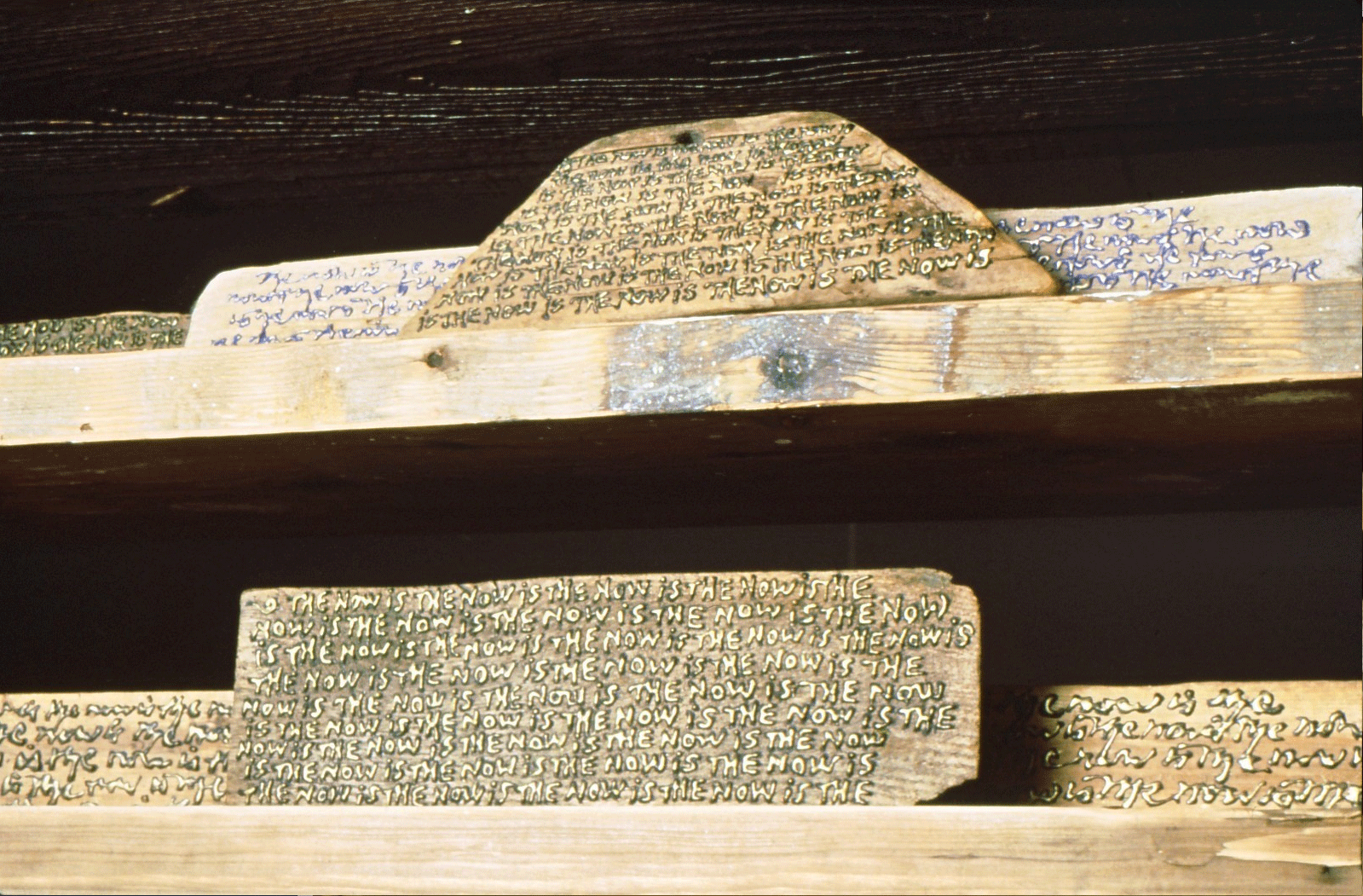
83 Words in one thing: one thing in 83 times; 83 times in one sutra
1988
“Stone sutra” curving on lime stone, 1988
1982
“One thing in thirty-four words: thirty-four words in one phrase: one phrase in thirty-four changes”
acrylic on drifted wood, 1982
1982
“29 words in 1 phrase: 1 phrase in 29 things: 29 things in 1 work”
acrylic on drifted wood, 1982
1982
“83 Words in one thing: one thing in 83 times; 83 times in one sutra”
acrylic on drifted wood, 1982
I am still writing “the now is”
I am still thinking about it.
1982
“One thing in thirty-four words: thirty-four words in one phrase: one phrase in thirty-four changes”
acrylic on drifted wood, 1982
“29 words in 1 phrase: 1 phrase in 29 things: 29 things in 1 work”
acrylic on drifted wood, 1982
“83 Words in one thing: one thing in 83 times; 83 times in one sutra”
acrylic on drifted wood, 1982
One thing in thirty-four words: thirty-four words in one phrase: one phrase in thirty-four changes”
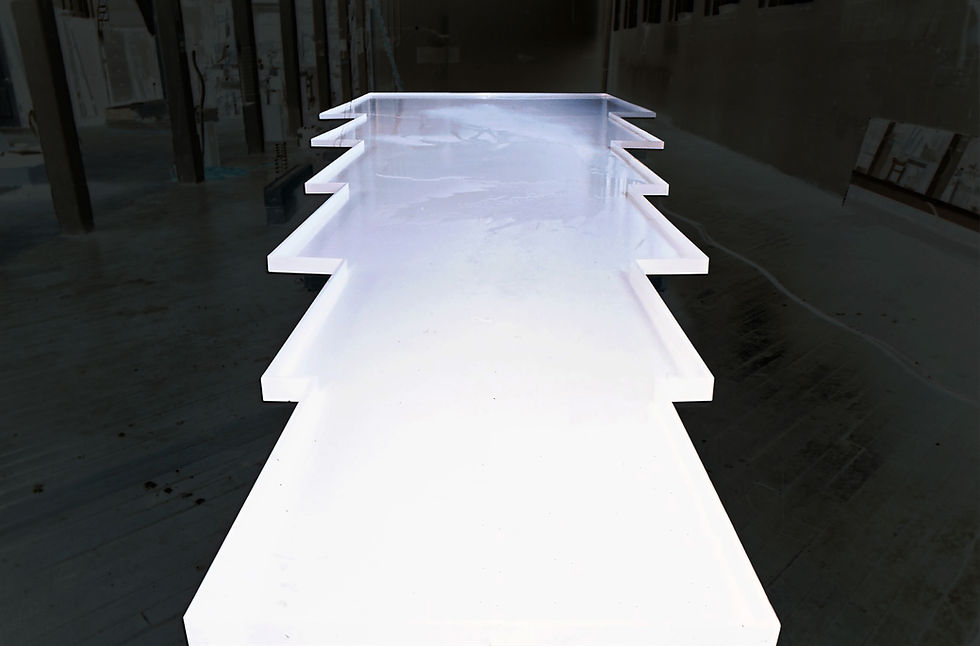
"See-Through Aquarium Instrument" - Plywood with waterproof deck paint, 12x64x1 ft., speaker, microphone, amplifier. Gowanus Memorial Art Yard, Brooklyn, New York, 1981
1981
John Shell “Talk of Town,....It is called ‘The’ sound”, he told us that the sound is the melody of time,...feeling vibration of the time is sound...with both 2 fingers quotation mark...”,
John Shell, The New Yorker magazine, 7.27
1981
John Perreault “gigantic...performance of his ‘The’ sound; this water pool sound
instrument was the most visual thing I had come across yet.”
John Perreault, The Soho News, newspaper, 5.27

1979
Kay Larson “built a pool and amplified the sound of water
dripping into the center plop, plop, plop,...
It was a contemplation piece; you were to focus your attention on
the plop sound and notice that it seemed disconnected from the image of the droplet
...entering into the mood of a work like this gets harder as the years drag on.”
Kay Larson, Voice, weekly newspaper, 10.2
1979
“Meditation”, PS 1 Museum, 1979 (Water pool, sound, light)

"Aquarium Rakugei: Meditation" Plywood, waterproof deck paint, water, microphone, speaker, audio amplifier. Special Exhibition, MOMA PS1, 1979


"Driftwood Sutra" Hudson River Driftwood. Acrylic and gold leaf, Westbeth, New York, 1977
1977 From the top left page of a double-page spread on a desk.
1️⃣83 characters as one; 83 times each; 83 times as one sutra.
2️⃣23 characters in one phrase; 23 characters as one event, one work.
3️⃣34 characters as one: 34 characters in one phrase: 34 events in one phrase.
4️⃣44 characters as one thing; 44 cycles of one thing.
3️⃣A driftwood piece with the number 3 in the center.
From the top right page of a double-page spread on a desk.
5️⃣9 columns as one thing: 9 strokes for one thing: 9 strokes for one phrase.
6️⃣108 pieces of scrap wood with sutras written on them: One re-creation of 108 pieces of scrap wood.
7️⃣7 columns as one word: 7 columns as one surface: 7 days as one surface.
8️⃣8 words as one phrase: 8 people as one event: 8 people breathing simultaneously.

German translation by Bernd Jansen above type description. 1977, 1989
Background: "STATE OF THINGS: The Ecology of Things," St. Michael's College, Vermont, 1977
STONE SUTRA: 一石経

"The Now Is" inscription written counterclockwise, ink on limestone,
perforated at the beginning and end of the inscription, one of the prayer beads, 1991, private collection, USA


